

US eSIM prices by plan duration and coverage region
Compare US eSIM prices by trip length and coverage region. Learn how to choose data, check device compatibility, and install your plan before you travel.
The cheapest US eSIM isn’t automatically the best fit for your trip. The right option depends on how long you need data, how much you expect to use, and whether you need coverage in the United States alone or across multiple destinations.
It’s reasonable to want a clear cost before you travel, especially when plans differ in duration and coverage. This guide explains how those choices affect plan costs, what to compare, and when to install your eSIM so it’s ready when you arrive.
You’ll also learn which devices are commonly compatible, including eligible iPhone and Google Pixel models, and what to look for if you’re planning to travel beyond major US destinations. With the right plan and a compatible device, you can prepare for maps, messages, and other everyday data needs before your trip begins.
Key Takeaways
- Match your data allowance to trip length: short stays and longer visits call for different plan sizes.
- Compare coverage areas as well as duration, especially if your itinerary includes remote parts of Alaska or Montana.
- Install your eSIM before travel, then activate it when you’re ready to connect in the United States.
- Check your device’s eSIM support before choosing a plan, and compare local and regional options for your route.
Table of Contents
Why use an eSIM in the United States?
Travel eSIM providers sell prepaid US data plans, with prices depending on the data allowance and coverage. There is no single price for every plan. An eSIM is a digital profile installed on a compatible phone. You select it in your mobile settings to connect in the United States without inserting a physical SIM card.
Plan prices and data allowances
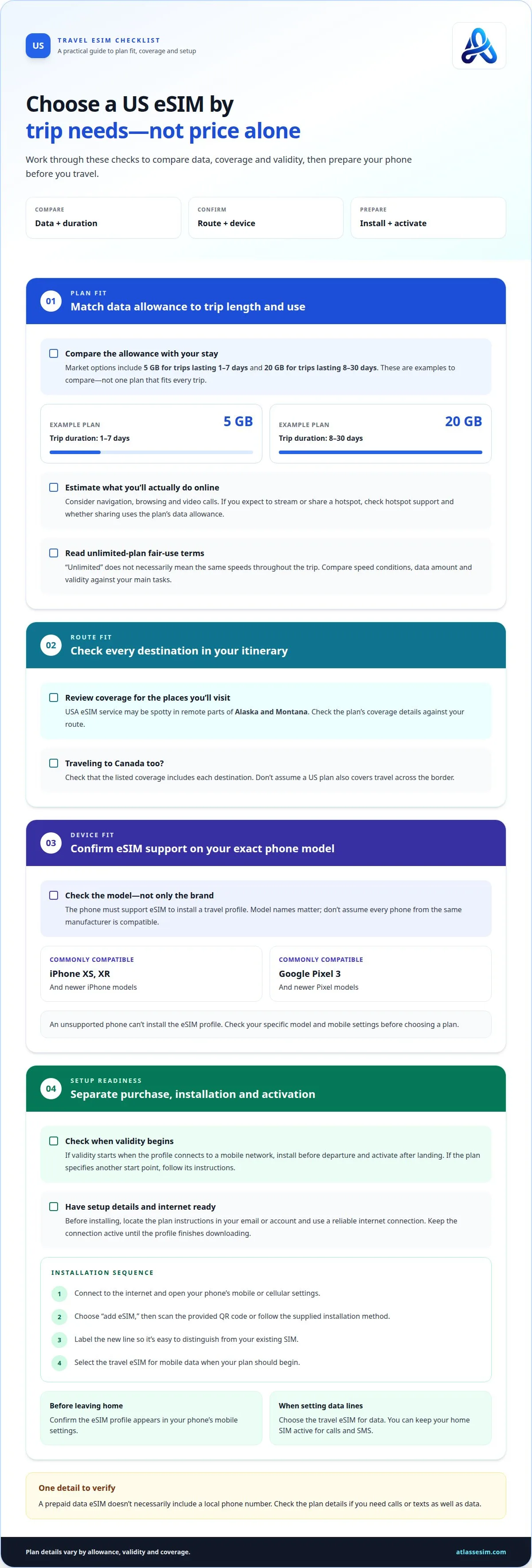
Compare the data included with each plan against your trip length and likely use. Market options include 5 GB prepaid plans for trips lasting 1-7 days and 20 GB plans for trips lasting 8-30 days. The price varies with the allowance and validity, so compare those details before choosing rather than judging by the upfront amount alone.
Estimate your data needs based on activities such as video calls, navigation, and browsing. If you plan to share your connection, check whether hotspot use is supported and whether it draws from the plan’s data allowance. Also compare how long the plan remains active.
Unlimited data and fair-use speeds
“Unlimited” describes the plan’s data option, but it doesn’t necessarily mean the same speeds throughout your trip. Read the fair-use rules for details on how the plan handles heavy use. This matters if you rely on video calls, streaming, or a mobile hotspot rather than mainly using maps and messages.
Match the plan to your main tasks. A traveler using navigation and messaging has different needs from someone streaming video daily. Compare speed conditions alongside the unlimited label, and consider a fixed allowance if its data amount and validity better suit your travel routine.
Data usage and eSIM connectivity
After downloading the eSIM, choose it for mobile data in your phone’s settings; keep your usual line available for other functions if needed. Switch data lines deliberately so apps use the intended connection. Before traveling, review your route and coverage details, especially for remote parts of Alaska and Montana, where USA eSIM service may be spotty.
If your itinerary includes Canada, compare the plan’s listed coverage with every destination instead of assuming a US plan extends across the border. Consider how much data you’ll use for maps, video, and hotspot sharing, then choose a plan whose allowance and validity fit the trip.
When should I install my eSIM?
Tourists can buy prepaid travel eSIMs without a US address or credit check. To get connected, install the profile using your phone’s settings, then select it for mobile data when you’re ready to use it in the United States.
Treat purchase, installation, and activation as separate steps. Check when the plan’s validity begins so you know when to install the eSIM and when to start using it.
Purchase and setup timing
Buy your plan before departure so you can read its instructions and prepare your phone. Before installing, find the plan details, the email or account containing its setup instructions, and a reliable internet connection. Keep access to that connection until the eSIM profile finishes downloading.
Read the plan’s validity terms before installation. If validity begins when the profile connects to a mobile network, install it before departure and activate it after landing. If the plan specifies a different start point, follow its instructions. This helps you avoid starting the plan before you need it.
A prepaid data eSIM doesn’t necessarily include a local phone number. Review the plan details, especially if you need calls or texts as well as data.
Installation and activation steps
Use this sequence for setup:
- Connect your phone to the internet and open its mobile or cellular settings.
- Choose the option to add an eSIM, then scan the provided QR code or follow the supplied installation method.
- Label the new line so you can identify it separately from your existing SIM.
- Select the eSIM for mobile data when your plan should begin.
Menu names vary by phone, so follow the on-screen prompts for your model. Keep your home SIM active for calls and SMS if you want, and select the travel eSIM for data. If installation pauses, keep your internet connection active and reopen settings to continue. Before leaving home, confirm that the eSIM profile appears in your phone’s mobile settings. This makes it easier to manage your connection on arrival.
Compatible devices
Your phone must support eSIM before you can install a prepaid travel plan. Check your model and mobile settings before buying, then confirm that eSIM is supported. Atlas eSIM works on most iPhone XS and newer models, and many recent Android devices. Check our compatible devices list before you buy.
Commonly compatible models include iPhone XS, iPhone XR, and newer iPhones. Google Pixel 3 and newer models are also listed as compatible. Model names matter: don’t assume every phone from the same manufacturer supports eSIM. Check the exact model, not just the brand or operating system.
What are the drawbacks and risks of using an eSIM in the US? An unsupported device can’t install the profile, and coverage varies by location. Setup also requires access to the instructions and an internet connection to download the profile before you rely on mobile data.
An eSIM stores its profile on your phone, while a physical SIM is a removable card. A pocket Wi-Fi device provides a separate connection that your phone joins. With an eSIM, your compatible phone connects directly. You can keep your home SIM active for calls and SMS.
Compare prepaid plans by checking device compatibility, coverage, validity, data allowance, and hotspot availability. Unlimited plans have fair-use rules, so read them before choosing. Compare plans against the same needs rather than price alone: one plan may not fit every phone or travel route.
Before you arrive, download essential apps such as maps and messaging tools while connected to the internet. After installation, select the travel eSIM for mobile data in settings. Your phone may not switch to it automatically, so confirm the selected data line before opening apps. You can keep your home SIM active for calls and SMS.
Pricing by plan duration and coverage region
Plan value depends on how long you need data, the allowance, and where you’ll travel. A USA DayPass listing has a validity period of 1-90 days, while prepaid choices also vary by data amount and coverage. Compare the full validity and allowance, not just the plan label.
For a short stay, a 5 GB plan lasting 1-7 days may fit light browsing, maps, and messaging. For a longer visit, a 20 GB plan lasting 8-30 days provides a larger allowance. Estimate your video, navigation, and hotspot use before choosing, since heavier use can consume data faster.
Regional plans can cover the United States along with other destinations. They may suit an itinerary that crosses borders, such as a trip combining the United States and Canada. Compare each plan’s listed destinations and validity to choose coverage that fits your route.
Do US eSIM plans include 5G, hotspot data, and nationwide coverage? Some listings specify 5G/4G access, but a network label doesn’t guarantee the same speeds everywhere. Hotspot access and coverage depend on plan terms and local network partners, so check those details against your destinations.
Coverage describes where a compatible plan can connect; speed describes how that connection performs. Network availability can vary between cities, highways, and remote areas. A plan’s coverage wording doesn’t guarantee identical reception everywhere, so review its stated coverage and supported networks for your route.
For a regional plan, check that the United States and every other destination on your itinerary are listed in its coverage. Then compare the data allowance and validity. Choose a local plan for a US-only trip, or a regional option if you’ll visit multiple covered destinations.
Atlas eSIM: Local eSIM data plans
Atlas eSIM offers local data plans for travelers who need mobile data in the United States, as well as regional plans for trips across multiple destinations. Choose a local plan for a US-only itinerary; consider a regional plan when your route includes other covered countries.
Each plan displays its price and data allowance up front, helping you compare the plan details with your travel needs. Customers usually receive an installable QR code in under 60 seconds, so you can set up the eSIM before departure and prepare to connect when your trip begins.
Review the destination coverage, data allowance, and plan validity to find an option suited to your route. Visit Atlas eSIM to explore the available plans.
Make connectivity part of your travel plan
Before your trip, think about what you want your phone to help with: finding your accommodation, coordinating with travel companions, or handling a change of plans. That priority can guide your choice more clearly than a plan label alone. Choose a US eSIM that fits the way you’ll travel and the data you expect to use.
Make eSIM setup part of your pre-departure routine. Save essential travel details somewhere you can access them, decide which line to use for data, and keep the eSIM instructions handy. Then you can focus on your itinerary instead of sorting out settings mid-journey.
If you’d like help choosing a suitable option for your route, contact Atlas eSIM for help. A little preparation now can make it easier to stay focused on the places and people you’re traveling for.
Frequently Asked Questions
How much does an eSIM plan for the USA cost?
A US eSIM plan’s cost depends on its validity, data allowance, and coverage region. A short city break may need less data than a longer trip with frequent video calls or hotspot use. Compare plans with similar allowances and coverage, then check how long each stays active. This gives you a more useful comparison than choosing by the lowest displayed price alone.
Can I reuse my eSIM?
Whether you can reuse an eSIM profile for another trip depends on the plan and device. Reuse depends on the plan’s validity and whether the profile can remain installed or be transferred. If you’re planning another visit after your current data runs out, check whether the plan supports a top-up or whether you’ll need a new one. Don’t delete a working profile until you know.
Do eSIMs have unlimited data?
Some travel eSIM plans offer unlimited data, while others provide a capped allowance. Unlimited plans have fair-use rules, so read them before relying on high-speed data for work calls or streaming. If you’ll use a hotspot for a laptop, check whether hotspot sharing is available on the plan and review its fair-use rules too.
Does Your Phone Support eSIM USA?
Your phone supports a USA eSIM only if its specific model supports eSIM. Look in mobile or cellular settings for an option to add an eSIM. If you can’t find it, check the device’s specifications before buying a plan. Also confirm that the phone is compatible with the plan’s network requirements. A familiar brand name alone doesn’t establish compatibility.
USA eSIM vs SIM Card vs WiFi: Which is Better for Travel?
An eSIM suits travelers who want mobile data directly on a compatible phone, while a physical SIM uses a removable card. Pocket Wi-Fi is a separate device that provides a connection for nearby devices. For a solo traveler navigating with one phone, an eSIM keeps the connection on that device. For a group sharing data, pocket Wi-Fi may suit the arrangement better.
Which phones are compatible with US eSIM plans?
Most iPhone XS and newer models, and many recent Android devices, support eSIM. Commonly listed examples include iPhone XS, iPhone XR, and newer models, plus Google Pixel 3 and newer. Compatibility can depend on the exact model, so check the phone’s eSIM settings and the plan’s compatible-device list before purchase. That’s especially useful if you own a regional model.