

Morocco eSIM plans, pricing and network coverage
Compare Morocco eSIM plans, pricing and network coverage. Learn how to check phone compatibility, choose data, and stay connected across your trip with ease.
What if staying connected in Morocco didn’t mean changing the SIM you already use? A Morocco eSIM gives your compatible, unlocked phone a digital way to connect to mobile data, so you can get online for maps, messages and trip planning without swapping a physical SIM.
It’s sensible to get clear answers before you travel: whether your phone supports eSIM, how much data you may need, and how coverage works. This guide explains setup and what to compare when choosing a plan, so you can prepare with confidence.
You’ll also learn how local mobile networks affect coverage, why signal can vary between cities and more remote areas, and how trip length and everyday data use can help you choose an allowance. The goal is to help you find a practical connection for your journey and know what to expect before you arrive.
Key Takeaways
- Confirm your phone supports eSIM and is unlocked before choosing a digital plan.
- Expect coverage to vary between cities and remote areas, so consider your route as well as your destination.
- Match your data allowance to how long you’ll travel and how you use maps, messaging, and other online services.
- Learn how an eSIM can keep mobile data separate from your usual SIM and make arrival connectivity simpler.
Table of Contents
ESIM for Morocco, how does it work?
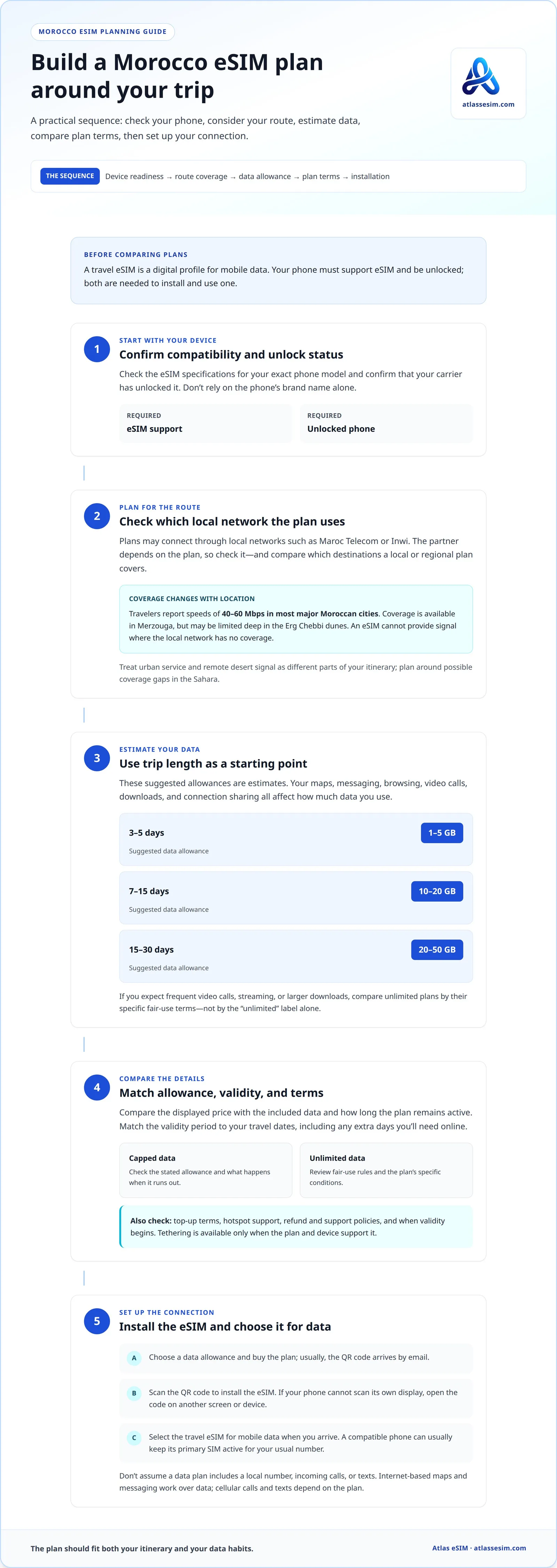
A Morocco eSIM is a digital profile that connects a compatible phone to mobile data without inserting another SIM card. Before buying, confirm your phone supports eSIM and is unlocked. Both are needed to install and use a travel eSIM.
Device Compatibility and Primary SIM Use
Compatibility depends on your exact phone model and whether the carrier has unlocked it. Check the manufacturer’s eSIM specifications for your device instead of relying on the brand name alone. A compatible phone can usually keep its primary SIM active while using the eSIM for data, so you can retain your usual number for calls or texts.
It is also wise to ensure your device is in good working order before travelling abroad; professional phone technicians such as SIMSIM Repairs can address any battery, screen, or hardware issues so your phone remains dependable during your trip.
In your phone settings, select the travel eSIM for data and assign the primary line as needed. Don’t assume a data plan includes a local phone number, incoming calls or texts. Internet-based services, such as Google Maps and messaging apps, work over data; cellular calls and texts depend on the plan.
Morocco eSIM Purchase, Installation, Activation, and Top-Ups
Usually, you choose a data allowance, buy the plan and receive a QR code by email. Scan the code to install the eSIM, then select it for mobile data when you arrive. If your phone can’t scan its own display, open the QR code on another screen or device.
Top-ups depend on the plan’s terms, so check whether you can add data or need a new plan. When comparing Ubigi, Jetpac and Pingwe, look at allowance, validity, supported network and top-up terms rather than assuming their packages are alike.
An eSIM uses a mobile network, so its reliability depends on local coverage, including networks such as Maroc Telecom. A WiFi router creates a separate hotspot for connecting devices, while an eSIM works through a compatible phone. A physical SIM requires a handset slot and a card swap. Before buying, review the plan’s refund and support policies, data limit and validity. “Unlimited” plans can have specific terms, so check how the provider defines usage.
Mobile network coverage in Morocco
Coverage depends on local networks and your route. The plan’s partner network matters, particularly when travelling beyond Morocco’s major cities.
Coverage and Partner Networks
Morocco eSIM plans can connect through local networks, including Maroc Telecom and Inwi. The available partner depends on the plan, so check which network it uses before buying. An eSIM connects through that network where service is available; it can’t provide a signal where the local network has no coverage.
For a trip across several destinations, compare a local plan with a regional plan by checking which places each covers. This shows whether one plan can support your full itinerary or whether coverage may vary between countries.
Connectivity Across Cities, Rural Areas, and the Sahara
Travelers report mobile speeds of 40-60Mbps in most major Moroccan cities. Coverage is available in Merzouga, but may be limited deep in the Erg Chebbi dunes. Treat city service and remote desert signal as different parts of your route, rather than assuming the same connection throughout.
4G or 5G availability depends on the local network and location. Tests in February 2026 covered Marrakech and a remote location roughly 30 minutes outside the city, illustrating why conditions can vary beyond urban areas. For Sahara travel, plan around possible gaps in mobile coverage.
Network Speeds and Data Allowances
Speed affects how quickly maps load, messages send, or files transfer, while coverage determines whether the phone can connect at all. According to OpenSignal, its Morocco report published in April 2025 offers a detailed breakdown of network performance. Use local performance information as context, not as a promise of speed at every stop.
Tethering and hotspot use are available only when the plan and device support them. Check the plan’s hotspot terms alongside its data allowance, especially if you’ll connect a laptop or share data while travelling between cities.
Morocco eSIM plan types, data allowances, and pricing
Choose a data plan by considering your trip length, expected internet use and the plan’s validity. A Morocco eSIM may offer capped or unlimited data, with different terms to weigh for each option.
Available Plan Types and Data Allowances
For trips lasting 3 to 5 days, a suggested allowance is 1 GB to 5 GB. For 7 to 15 days, consider 10 GB to 20 GB; for 15 to 30 days, the suggested range is 20 GB to 50 GB. These ranges help you estimate needs, but your habits matter too.
Maps, messages, browsing, video calls and downloads use data differently. Think about which activities you’ll rely on, including whether you’ll share a connection. A capped plan states its allowance, while an unlimited plan still has terms to review.
Plan Prices
A plan’s price depends on its allowance, validity and data type. Compare the displayed price with the included data and how long you can use it. This helps you assess a Morocco eSIM against your itinerary, rather than choosing by headline price alone.
Prepaid plans show the price and data allowance before checkout. Compare them together, then decide whether a capped package fits your needs or a different plan structure makes more sense for your trip.
Unlimited Data Package Durations and Prices
Unlimited data may suit travelers who expect frequent video calls, streaming or larger downloads. Check the plan’s validity too, and review its fair-use rules, which can shape how the service is managed.
Compare the plan’s duration and fair-use rules before choosing. If you mainly need navigation and messaging, a capped allowance may be a better fit. For heavier use, compare unlimited options by their specific terms, not the label alone.
Plan Validity Periods
Validity tells you how long a plan remains active; the allowance tells you how much data it includes. Match both to your travel dates, including any extra days when you’ll need maps, messages or online access.
Before buying, check when the plan’s validity starts and what happens when the allowance runs out. The right Morocco eSIM is one whose active period and data limit suit your schedule and typical usage.
Benefits of eSIM connectivity in Morocco
A travel eSIM makes it easier to arrange mobile data before a trip to Morocco. Install the digital profile before departure, then select it for data when you’re ready to connect. This means you can get online for maps, messages and travel updates without needing to find a SIM card counter after landing.
The main benefit is convenience, not a promise of uninterrupted service. An eSIM relies on its partner network, so your phone may lose signal where local coverage is limited. If you travel between a city and a remote area, for example, connectivity depends on the network available along the route. An eSIM changes how you access mobile data, not where network coverage reaches.
Keeping your primary SIM active can simplify your travel routine. Use the eSIM for data and retain access to your usual line, depending on your phone settings and plan features. This can help you use online navigation while staying reachable on your regular number. Calls, texts and data are separate, so check what the plan supports.
For remote work, an eSIM can provide a mobile connection without a separate WiFi router. You can connect a laptop through your phone’s hotspot when the plan and device support tethering. Before relying on it for a video call or file upload, consider your data allowance and network availability at your destination. Heavy downloads can use data faster than messaging or browsing.
For a multi-country itinerary, a regional plan may reduce the need to manage separate data plans across borders. For a Morocco-only stay, a local plan may be the more direct fit. Compare coverage, validity, data limits, and hotspot terms before choosing, then choose a Morocco connection plan that matches your route and usage.
Atlas eSIM
Atlas eSIM offers local eSIM data plans for Morocco and regional plans for travel across multiple countries. Choose based on whether your itinerary stays in Morocco or crosses borders, then compare the plan’s data allowance with your expected use.
Plans show their price and data allowance upfront, helping you understand the package before purchase. Customers usually receive an installable QR code in under 60 seconds. This can make a digital plan a practical next step if you want to arrange mobile data before your trip and avoid swapping a physical SIM card.
If you’re ready to explore a plan for your route, contact Atlas eSIM.
Plan your connection around the trip ahead
Before travelling, decide which parts of your routine need mobile data. Navigation, messaging and remote work can shape what you need from a Morocco eSIM, while your itinerary helps you decide between a country-specific plan and a cross-border option. Keep the choice practical: focus on your route, usual online activities and how you prefer to stay reachable.
Atlas eSIM offers Local eSIM data plans and Regional Plans for travelers choosing connectivity for Morocco alone or a wider journey. If you want help deciding which option fits your trip, contact Atlas eSIM. With your route and data needs in mind, you can make a clear choice and get ready to travel with fewer connectivity decisions left for arrival.
Frequently Asked Questions
When should a provider arrange eSIM installation?
Install a Morocco eSIM before departure so it’s ready for your arrival. Atlas eSIM usually delivers the QR code in under 60 seconds after payment, allowing you to set up the profile ahead of your trip. Activate the line for mobile data when you’re ready to connect in Morocco. If setup questions come up, support is available 24/7 via WhatsApp or email.
Can I reuse my eSIM?
Don’t assume an eSIM profile can be transferred to another phone or reused for a different trip. Reuse depends on the profile and plan terms, including whether the plan is still active and supports a top-up. The Atlas eSIM app lets you manage and top up eSIMs after activation. A top-up adds data to a plan; it doesn’t mean the profile can be moved to another device.
Which eSIM providers offer coverage in Morocco, and which local networks do they use?
Travel eSIM plans connect through local networks, including Maroc Telecom and Inwi. The network used by a Morocco eSIM depends on the particular plan, so the provider’s name alone doesn’t tell you which local network it uses. If your itinerary includes both city and remote stops, consider the plan’s listed network alongside your route and coverage needs.
What affects the cost of an eSIM for different data amounts and trip durations?
Cost varies with the data allowance, validity, and plan type, so there isn’t one price for every trip. Suggested allowances are 1 GB to 5 GB for 3 to 5 days, 10 GB to 20 GB for 7 to 15 days, and 20 GB to 50 GB for 15 to 30 days. Atlas eSIM displays prepaid plan prices before checkout.
Which plans include unlimited data, calls, or SMS?
Atlas eSIM offers Unlimited Data plans with fair-use rules shown upfront. Unlimited data means mobile internet; it doesn’t automatically include a local phone number, cellular calls or SMS. Check the plan’s inclusions if you need voice or text service. Internet-based calling and messaging apps use data and need an internet connection.
Is my phone compatible with eSIM and unlocked for use in Morocco?
Most iPhone XS and newer models, and many recent Android devices, support eSIM, but compatibility depends on the exact model. Your phone also needs to be unlocked to use another network’s plan. Check your device model and carrier status, then review Atlas eSIM’s compatible devices list before you buy. This helps prevent purchasing a plan your phone can’t install.