

Japan eSIM: Compare Plans for Coverage, Data and Your Phone
Find the best esim for japan by checking phone compatibility, coverage, data limits, and local or regional plans for your route and travel habits before you go.
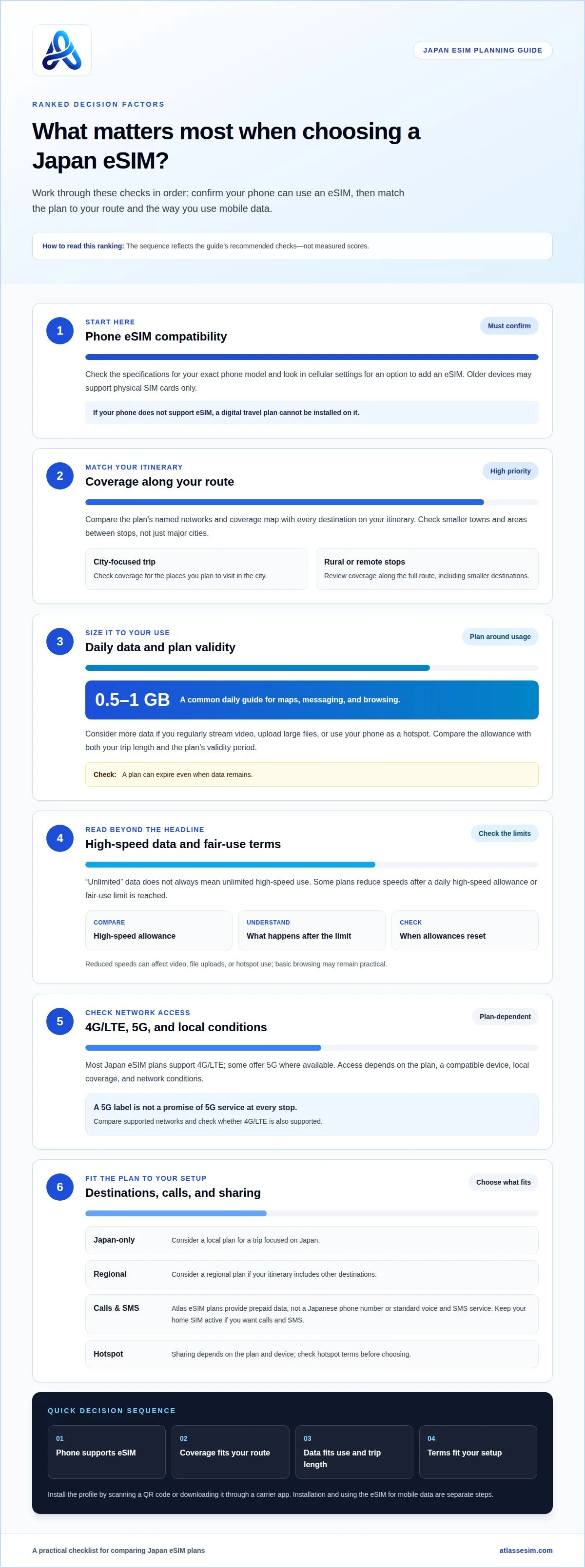
The best eSIM for Japan is one that works with your phone, covers the places you plan to visit, and gives you enough data for your trip. A common planning guide is 0.5 to 1 GB of mobile data per day for maps, messaging, and browsing. Choose a plan around your route and usual phone use, rather than focusing on data allowance alone.
Choosing the best eSIM for Japan starts with two checks: confirm your phone supports eSIM, then match the plan’s coverage and data terms to your itinerary. This helps you avoid buying a plan that does not fit how or where you’ll travel.
This guide explains how eSIMs work, how to check compatibility, and what to compare when choosing a Japan plan. It also covers local and regional options, so you can choose a plan that suits your route and phone use.
Key Takeaways
- Confirm your phone supports eSIM before choosing a plan, then follow the installation steps before your trip.
- Estimate your daily data needs from the travel activities you rely on, and compare allowances and usage limits.
- Match network coverage to your route, especially if you’ll travel beyond major cities, and check whether 4G/LTE or 5G access suits your needs.
- Choose between a Japan-only plan and a regional plan based on where else you’ll travel and how you want to stay connected.
Table of Contents
Is my phone eSIM compatible?
Your phone needs built-in eSIM support to install a digital travel plan. Check the device maker’s specifications for your exact model, then look in its cellular settings for an option to add an eSIM. Older devices may support physical SIM cards only, so confirm compatibility before choosing a plan.
Installation usually follows one of two routes: scan a QR code or download a profile through a carrier app. Keep the QR code accessible on another screen or printed page if you’re installing it on the same phone. Follow the provider’s instructions, add the profile, and select it for mobile data when you’re ready to connect in Japan.
Installing an eSIM and using it for mobile data are separate steps. You can install your Atlas eSIM before departure and start using data when you begin using it at your destination. Check your phone settings to choose which line handles mobile data, calls, and messages. Atlas eSIM provides prepaid data plans, so keep your home SIM active for calls and SMS if you want.
| Option | Installation | Network performance | Sharing |
|---|---|---|---|
| QR-code eSIM | Scan the provider’s code | Usually 4G/LTE; some plans offer 5G where available | Depends on plan and device |
| App-based eSIM | Download the profile in the carrier app | Compare supported networks and 5G access | Check hotspot terms |
| Pocket Wi-Fi | Connect devices to a separate hotspot | Depends on its network connection | Designed to connect multiple devices |
Most Japan eSIM plans support 4G/LTE, while some provide 5G where available. Performance also depends on local coverage, your device, and network conditions. Compare providers by supported networks, coverage along your route, and any stated hotspot limits, not by a speed claim alone.
For a practical choice, confirm your phone supports eSIM, then select the installation method and sharing setup that fit your devices.
Why use an eSIM in Japan?
A travel eSIM gives your phone mobile internet without swapping its physical SIM. Its drawbacks can include data caps, expiry dates, reduced speeds under fair-use rules, and limited calling options. Check those terms before purchase to avoid choosing a package that doesn’t fit your trip.
Data Use and Plan Allowances
A common guide for Japan is 0.5 to 1 GB of mobile data per day for maps, messaging, and browsing. Add more if you regularly stream video, upload large files, or use your phone as a hotspot. A capped data plan suits predictable use; compare its allowance with your trip length and validity period. A package can expire even when data remains, so match both details to your itinerary.
Unlimited Data and Fair-Use Limits
“Unlimited” describes the plan’s overall data access, but it doesn’t always mean unlimited high-speed use. Some eSIM providers apply a daily high-speed allowance or fair-use policy, then reduce speeds after you reach a limit. That can affect video, file uploads, or hotspot use while basic browsing may remain practical. Compare the high-speed allowance, speed changes, and reset timing, not just the unlimited label.
Data-Only Plans and Calling Options
Atlas eSIM plans provide prepaid data, not a Japanese phone number or standard voice and SMS service. Internet-based calls and messages can work through apps when you have data access. Keep your home SIM active for calls and SMS if you want, and select the eSIM as your mobile data line to control which connection handles internet use.
Which network offers the best coverage in Japan?
Travel eSIMs use mobile networks available through their carrier arrangements in Japan, so the network listed for a plan matters. Most Japan eSIM plans support 4G/LTE, while some offer 5G where available; outside major cities, compare coverage along your route.
Japanese Networks and 5G Availability
A Japan eSIM connects your device to the local network or networks supported by its plan. Carrier access varies by package, so compare the networks named in each plan rather than assuming every eSIM uses the same one. Most plans support 4G/LTE, while some include 5G where available. 5G access depends on the plan, compatible device, and local network coverage.
Network performance also changes with location and conditions. A 5G label describes supported access, not a promise of 5G service at every stop. Check whether the plan can use 4G/LTE as well, which gives your device another supported network type when 5G isn’t available.
Coverage Beyond Major Cities
For rural or remote stops, a city-focused comparison won’t tell the whole story. Check the eSIM provider’s coverage map against your itinerary, including smaller towns and the areas between destinations. A route through central Tokyo has different coverage needs from one that includes remote regions.
A broad “Japan coverage” label does not explain whether a plan suits your whole itinerary. Review the destination and coverage details shown for the plan, then compare them with the places you plan to visit. This helps you choose based on your route rather than the label alone.
Before buying, compare the plan’s destination coverage with your itinerary and review the data terms. Also confirm that your phone supports eSIM. Pocket Wi-Fi and eSIM plans both rely on mobile network coverage, so check that the option you choose fits your route.
Roaming describes how a travel eSIM can access service through a partner network instead of your usual carrier’s network. The available partner and coverage can differ between packages. For the best fit, prioritize the network coverage map for your route, then consider 5G access and your phone’s compatibility.
Benefits of using an eSIM while traveling
An eSIM installs as a secondary digital line, so you can keep your home SIM active for calls and SMS. Install your travel profile before departure, then select it for mobile data after landing in Japan. This can help you use maps, messaging, and other online tools without looking for a local SIM.
The right plan depends on how many destinations are on your itinerary. A local plan suits a trip focused on Japan, while a regional plan can suit travel across multiple destinations. Compare the destinations included and the plan’s data terms with your route before choosing.
A device can store multiple eSIM profiles, which can help you keep local and international connectivity available. You can retain your usual profile while using a travel profile for data. This separation makes it easier to choose which line handles mobile internet, while your regular number remains available for services tied to that line. Exact settings depend on your device.
There are practical limits. An eSIM needs a compatible device, and a data plan may not include ordinary calls or SMS. Some eSIM plans offer a Japanese phone number for calls and messages, while others focus on internet access. Decide whether app-based calls meet your needs, or whether a local number matters for bookings and direct calls.
For a smoother arrival, install your travel eSIM before departure, select it for mobile data when you reach Japan, and keep your home SIM active for calls and SMS if you want. Before choosing a local or regional plan, compare its destination coverage and data terms with your itinerary.
Choose the option that matches your route and how you use your phone. Plan your Japan travel connectivity around the destinations you’ll visit.
Atlas eSIM
Atlas eSIM offers local and regional prepaid data plans for travel in Japan and across multiple destinations. Compare the plan’s destination coverage and data allowance with your route and expected phone use. Prices and data allowances are shown before checkout, so you can review the details before choosing.
Customers usually receive an installable QR code in under 60 seconds. Install the profile on a compatible device before departure, then select it for mobile data when you’re ready to connect in Japan. A local plan suits a Japan-focused itinerary, while a regional option may fit travel across destinations included in that plan.
Contact Atlas eSIM to discuss which plan fits your route and connectivity needs.
Make connectivity part of your arrival plan
Before you travel, consider what you’ll need your phone for as soon as you arrive. Directions to your accommodation, a message to someone waiting, or an online booking can help you decide how much data you need. Include connectivity in your arrival plans, alongside saved travel details and a charged device.
The best eSIM for Japan is the one that fits your itinerary and everyday phone use, not simply the plan with the biggest data allowance. Compare coverage and data terms, then keep the installation instructions accessible for when you’re ready to connect.
If you’re ready to choose a plan for your trip, explore Japan eSIM options with Atlas eSIM. A little preparation now can make getting online one less thing to think about after landing.
Frequently Asked Questions
What exactly is an eSIM?
An eSIM is a digital SIM profile stored in a compatible device, rather than a removable card. A travel profile can be downloaded or added by scanning a QR code. For example, install a Japan profile before departure, then select it for mobile data after arrival. Your phone’s SIM settings let you manage the travel profile alongside your existing line.
Do Japan eSIMs support 5G and hotspot?
Some Japan eSIM plans support 5G where available, while most support 4G/LTE. Hotspot access depends on the plan, device, and its terms. If you want to connect a laptop, check the plan’s tethering details before choosing it. Atlas eSIM hotspot availability is shown on each plan page before checkout, and hotspot is available on most plans.
What are the best eSIM providers for tourists visiting Japan?
The best eSIM for Japan depends on your itinerary and mobile data needs. Compare the plan’s destination coverage, data allowance, validity, and any fair-use rules. If you need laptop access, check whether hotspot is available on the plan page before checkout. A Japan-focused plan may suit a trip in Japan, while a regional plan can suit travel across multiple destinations.
Which Japan eSIM offers unlimited data, and what are the fair-use limits?
Unlimited-data plans can have fair-use rules, so “unlimited” does not necessarily mean high-speed data without restrictions. Review the rules upfront and consider how they fit your needs, including video calls or hotspot use. On Atlas eSIM, fair-use rules for Unlimited plans are shown before checkout.
Do Japan eSIMs include a Japanese phone number, calls, or SMS?
Some Japan eSIM plans include a Japanese phone number for calls and SMS, while others provide data only. If you mainly use messaging or calling apps, data access may meet your needs. For hotel calls, local bookings, or SMS verification, look specifically for a plan that includes a number and voice or messaging service.
How fast is 5G coverage in Japan for popular travel eSIM providers?
There isn’t one speed that describes every Japan travel eSIM. Actual performance depends on the local network, your location, device compatibility, and network conditions. A plan’s 5G support doesn’t mean every destination has 5G access. Compare supported networks and coverage along your route, then treat advertised network types as access options, not a guaranteed speed.