

Europe eSIM plans compared by price and data
Find the best esim for europe travel: compare plan prices, data limits, coverage and validity, plus eSIMs, local SIMs and roaming for your trip with confidence.
Crossing a border shouldn’t mean starting your connectivity plan over. For a multi-country trip, the best eSIM for Europe travel is usually a regional plan that covers every stop on your itinerary and provides enough data for your phone use. Compare it with local SIM cards and roaming to see which option suits your trip.
It’s easy to focus on the advertised data allowance, but coverage, validity and the way you use data matter too. A small pack may suit maps and messages, while video calls and regular streaming call for more data. This comparison breaks down Europe eSIM options by price structure and data, then sets them alongside local SIM cards and roaming. You’ll see what to weigh before choosing, how to match a plan to your trip, and when one regional eSIM can make travel between countries simpler.
Key Takeaways
- Match regional coverage to every country on your itinerary so you can avoid changing plans at each border.
- Choose fixed data for predictable, lighter use or compare unlimited options if your trip involves heavier browsing and streaming.
- Weigh the convenience of an eSIM against local SIM cards and roaming by considering setup, coverage, and how you prefer to manage connectivity.
- Before choosing, compare each plan’s supported destinations, data allowance, validity, and compatibility with your phone.
Table of Contents
Why get one eSIM for Europe?
The best eSIM for Europe travel depends on your route, not just a regional label. A regional plan can keep mobile data on the same eSIM across covered countries, so compare its destination list with your itinerary.
Regional Coverage Across Europe
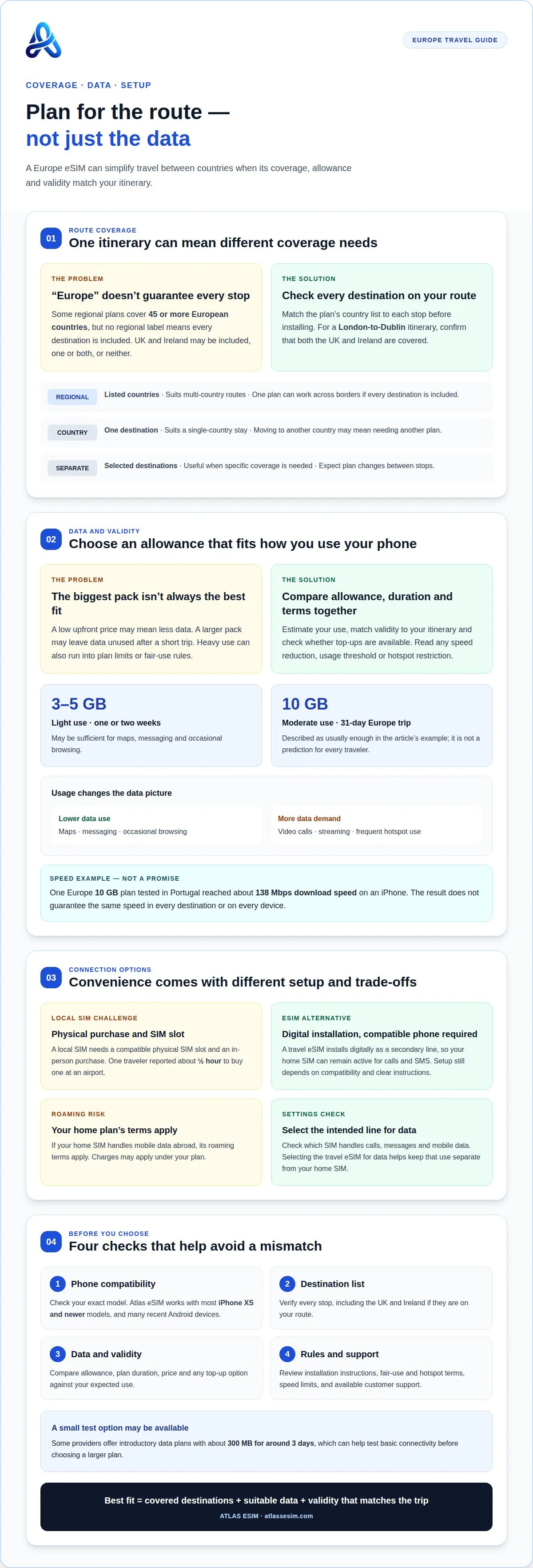
A regional eSIM is designed for use across multiple countries, letting you use one data plan for several travel stops. Some Europe plans cover 45 or more European countries, but that figure doesn’t mean every plan includes every destination. Check the country list before you download and install the eSIM. This option is useful when your route crosses borders and you want one plan for the covered legs.
Country Coverage by Destination
A country-specific eSIM focuses on one destination, such as France or Italy, rather than a multi-country route. It may suit a single-country stay, but a traveler moving from France to Italy could need another plan or a regional option. Compare the exact destination list instead of relying on the word “Europe.” Coverage in a country also doesn’t guarantee the same signal everywhere within it.
UK and Ireland Coverage
Check the UK and Ireland as separate destinations when comparing plans. A regional eSIM may include one, both or neither, depending on its country list. For a London-to-Dublin itinerary, confirm that both stops are covered before choosing one plan. A country-specific eSIM may suit a single destination, while a regional plan may fit a route that includes both.
| Option | Coverage | Best suited to | Border changes |
|---|---|---|---|
| Regional eSIM | Listed countries | Multi-country routes | One plan if destinations are included |
| Country eSIM | One destination | Single-country stays | May need a new plan |
| Separate country plans | Selected destinations | Trips needing specific coverage | Plan changes between stops |
To find the best eSIM for Europe travel for your itinerary, confirm your phone supports eSIM, then compare every destination with the plan’s coverage list.
Unlimited and fixed-data plan pricing
Fixed-data plans offer a defined amount of mobile data. Unlimited plans provide more headroom, but compare their fair-use rules and validity as well as the price shown before checkout.
Choosing Data for Your Needs
Start with what you’ll do on your device. Maps, messaging, and occasional browsing use less data than video calls, streaming, or frequent hotspot use. For light use, 3 to 5GB total may be sufficient for one or two weeks; for moderate use, 10GB is usually enough for a 31-day Europe trip. These examples help size limited data, not predict every traveler’s usage.
Compare the listed price with the data allowance and validity period. A lower upfront price may mean less data, while a larger pack could leave unused data after a short trip. Match the plan duration to your itinerary and consider whether you can top up if your usage changes. Price and allowance are more useful together than either figure alone.
Data Limits and Throttled Speeds
Fixed-data plans stop providing full-speed data when the allowance runs out, unless the plan provides another option. Unlimited data removes a set usage cap, but the term doesn’t always mean the same network speed throughout. Read the plan terms for any usage threshold, speed reduction, or limit on hotspot use. Those details affect whether unlimited suits video calls or sharing data with another device.
Network speed also depends on the connection available where you’re using the eSIM. One Europe 10GB plan tested in Portugal reached about 138 Mbps download speed on an iPhone, but that result describes a test, not a promised speed for every destination or device. Check that your phone is eSIM-compatible, then compare the plan’s stated data rules with your expected use. Choose fixed data for a defined allowance, or unlimited when flexible usage matters more than a precise cap.
Comparing eSIMs with local SIM cards and roaming
A travel eSIM installs as a secondary digital line, so you can keep your home SIM active for calls and SMS. Local SIMs and home-plan roaming work differently. Roaming charges may apply if your home SIM is selected for mobile data, and an eSIM doesn’t make internet traffic anonymous.
Compatibility and Customer Support
Before buying, check that your exact phone model supports eSIM. Atlas eSIM works with most iPhone XS and newer models, and many recent Android devices. Check our compatible devices list before you buy. Then compare plans by destination coverage, data allowance, validity, installation instructions and support. These details matter more than a broad regional label when you need data across several stops.
A local SIM card requires a compatible SIM slot and a physical purchase. One traveler reported that buying one at an airport took about 1/2 hour. By contrast, an eSIM can be installed digitally, but setup still depends on a compatible phone and clear instructions. Compare customer support access too: a visible help channel can make troubleshooting installation or connection problems easier during a trip.
Roaming Charges and Privacy Risks
Roaming uses your home mobile plan to connect through networks abroad. If your home SIM handles data, its roaming terms apply. Selecting a travel eSIM for mobile data helps keep that use separate. In your device settings, check which SIM handles calls, messages and data to reduce the chance of using the wrong plan.
Privacy needs attention with any mobile connection. An eSIM identifies your subscription to its network, but it doesn’t hide your online activity from every service or make you anonymous. Use secure connections for sensitive accounts, and avoid sharing login details on unfamiliar networks. Some providers offer introductory data plans with about 300 MB for around 3 days, which can help test basic connectivity before choosing a larger plan.
Using a Europe eSIM across multiple countries
A regional eSIM keeps one data plan in use across covered countries instead of requiring a plan change at every border. Match its destination list to your route, then prepare your phone before departure.
For a Paris, Rome and Dublin itinerary, confirm that France, Italy and Ireland are all included. A Europe label alone doesn’t show which countries the plan covers. Check the list before purchase and note any stops outside it. If a destination isn’t covered, you may need a separate option for that part of the trip.
Use this simple route check before installing an eSIM plan:
- Write down each country on your itinerary, including short stopovers.
- Compare every destination with the plan’s country coverage list.
- Install the plan on a compatible phone before you travel, following its setup instructions.
After arrival, select the travel eSIM for mobile data in your device settings. Keep your home SIM active for calls and SMS if you want, and confirm that the travel eSIM handles internet use. WhatsApp messages and maps need an internet connection, so check that mobile data works before leaving the airport or station.
At a border, check whether the next country appears in the plan’s coverage list. In a covered destination, you can keep using the same plan; an excluded country may need another connection. An eSIM doesn’t provide a local phone number unless the plan includes one. With a data-only plan, WhatsApp can still send messages over the internet.
For a multi-country journey, compare regional plans by their country lists first, then check the data allowance and validity against your route. Coverage, not a broad regional label, is the practical test of whether one plan fits.
Atlas eSIM: Local eSIM data plans
Atlas eSIM offers Local eSIM data plans for single-country stays and Regional Plans for journeys across covered destinations. Choose according to your itinerary: a local plan suits a focused visit, while a regional plan can fit a trip with several countries. Each plan displays its price and data allowance before checkout, making it easier to compare the details with your expected use.
After purchase, travelers usually receive an installable QR code in under 60 seconds. Install the eSIM before departure, then select it for mobile data when you arrive. This keeps setup digital and avoids swapping a physical SIM card during your trip.
For a practical next step, compare Atlas eSIM’s local and regional options with your route and data needs. Contact Atlas eSIM to explore the available plans.
Plan your connectivity before departure
Plan your connectivity before departure, rather than leaving it to the last minute. Map the countries you’ll visit, decide which phone tasks matter most, and choose a plan that covers your route. That makes finding the best eSIM for Europe travel a decision based on your itinerary, not a headline claim.
Think beyond arrival day, too. A setup that fits the full journey can help you avoid juggling connectivity decisions as your route changes. Atlas eSIM offers Local eSIM data plans and Regional Plans for different kinds of itineraries. If you’d like help choosing a plan for your route, contact Atlas eSIM for plan help. Make your choice, prepare your phone, and look forward to the trip ahead.
Frequently Asked Questions
Can I reuse my eSIM?
Whether you can reuse an eSIM depends on its validity and transfer rules. An expired plan won’t provide active data just because its profile remains on your phone. Moving a profile to another device also depends on its transfer terms. Before deleting an eSIM after a trip, review the plan details to understand whether it can be used again or needs a new installation.
Can I share data with other devices?
Yes, if your plan and phone support hotspot or tethering. Hotspot is available on most Atlas eSIM plans, and availability is shown on each plan page before checkout. For example, you can connect a laptop for email while traveling. Connected devices use the eSIM’s mobile data, so account for their expected use when choosing a plan.
When should I install my eSIM?
Install your eSIM before departure, while you have a reliable internet connection and time to follow the setup instructions. With Atlas eSIM, you can install before traveling and start using data when you begin using it at your destination. Keep your home SIM active for calls and SMS if you want, then select the travel eSIM for mobile data after arrival.
What are the best eSIM providers for travel in Europe in 2026?
There isn’t one best choice for every itinerary. Compare destination coverage, data allowance, validity, hotspot availability and support against your travel needs. Atlas eSIM offers local plans for single-country visits and regional plans for multi-country travel. Choose the prepaid plan whose coverage and data setup suit your route and phone use.
How much do Europe travel eSIM plans cost by data allowance and validity period?
There isn’t one fixed cost: plans vary by data allowance, validity and whether you choose capped or unlimited data. Compare plans with similar allowances and durations to find a suitable fit. Atlas eSIM shows the price and data allowance before checkout, so you can review the prepaid cost before choosing.
Which Europe eSIM plans include unlimited data, and what are their fair-use limits?
Atlas eSIM offers Unlimited Data plans, with fair-use rules shown upfront. Review those rules alongside the plan’s coverage and validity before choosing. “Unlimited” doesn’t mean there are no terms: consider whether you’ll stream, make video calls or use a hotspot, then choose a plan whose stated rules suit your travel habits.