

Europe Data eSIM Plans for 30-Day Trips
Choose a Europe data eSIM 30 days plan that fits your itinerary and data habits. Compare allowances, coverage, device compatibility, and setup tips for your ...
A Europe data eSIM for 30 days should match your full trip and your usual data use. If you rely heavily on the internet, you may need at least 20 GB; lighter use for maps, messaging, and occasional browsing calls for a different allowance.
Choosing data for a month abroad can feel like a balancing act: too little may run out before you return, while more than you need may go unused. The useful starting point is how you plan to use your phone, not simply the number of days you’ll be away.
This guide explains how to choose a 30-day data plan for travel across Europe, what to consider when estimating your usage, and which devices can use an eSIM. You’ll also learn how installation and activation fit into trip preparation, so you can arrive ready to connect without adding unnecessary steps to your plans.
Key Takeaways
- Match your plan’s country coverage to every stop on your itinerary, especially when crossing borders.
- Learn how eSIM installation and activation fit into trip preparation so you can plan for connectivity before arrival.
- Check your phone’s eSIM compatibility before choosing a plan; support varies by device model.
- Estimate your data needs from how you use your phone, then choose a 30-day allowance that suits your travel habits.
Table of Contents
Why get one eSIM for Europe?
A regional eSIM can keep mobile data simple across several countries. Match the plan’s country coverage and data allowance to your itinerary, rather than assuming every plan covers all of Europe.
Covered European Countries
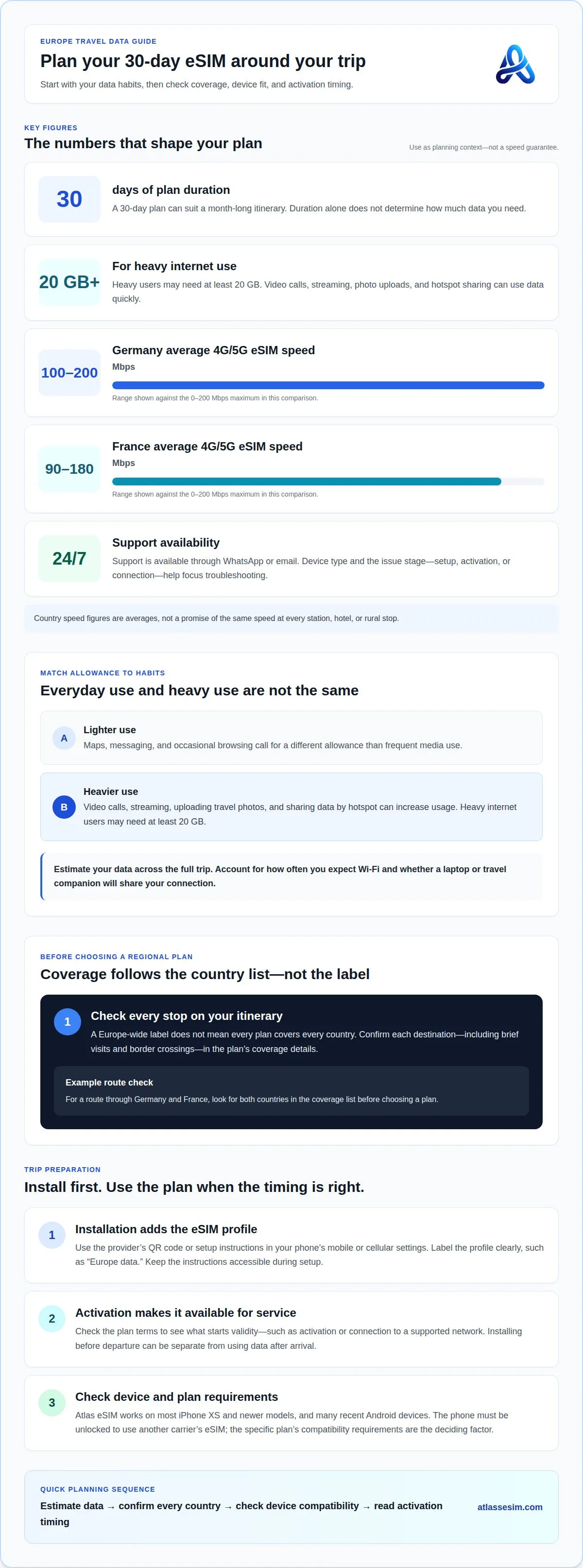
Europe-wide coverage can vary between plans, so the country list matters more than the regional label. For a route through Germany and France, look for both countries in the plan’s coverage details before choosing it. Add every stop, including countries visited briefly, to your itinerary check. This helps prevent a gap in mobile data when your journey crosses a border.
Connectivity Across Countries
An eSIM connects through mobile networks available in each covered country. Network access can therefore change as you travel; the country list and network details explain where the profile is intended to connect. Germany’s average 4G/5G eSIM speed is 100-200 Mbps, while France’s is 90-180 Mbps. These are country averages, not a promise of the same speed at every station, hotel, or rural stop.
Data Needs for a Multi-Country Trip
Estimate data across the full trip, not separately for each border crossing. Maps, messaging, and browsing use data differently from video calls, streaming, or uploading travel photos. Heavy internet users may need at least 20 GB for their eSIM plan. A hotspot can also use the allowance quickly when a laptop or travel companion shares the connection. Choose based on your habits and how often you expect Wi-Fi.
ESIM installation and activation
Installation adds the eSIM profile to your phone; activation connects it for travel data. Understanding the difference helps you prepare before you arrive and avoid starting plan validity too early.
Installation and Setup
A provider typically supplies a QR code and installation instructions for adding the profile. On a compatible phone, open the cellular or mobile settings, choose the option to add an eSIM, then scan the code or follow the supplied setup steps. Keep the instructions accessible while installing, especially if the phone needs an internet connection to complete setup. The profile stores the mobile plan information; it is separate from your usual physical SIM.
After installation, label the eSIM clearly, such as “Europe data,” so you can tell it apart from your regular line. Follow the plan’s instructions for when to start using mobile data. You can install your eSIM before departure and begin using data when you start using it at your destination.
Activation and Validity Start
Activation makes the installed profile available for mobile service. The plan’s terms explain what starts its validity period, such as activation or connecting to a supported network. That distinction matters for a 30-day trip: installing the profile before departure can be a separate step from using the plan after arrival. Read the activation instructions and timing details together before choosing when to activate.
For example, you can install the eSIM before your flight and use it for mobile data after arriving. Select the travel eSIM for data in your phone’s settings, and keep your home SIM active for calls and SMS if you wish. Installation and first use are separate steps.
Activation Period and Support
Check how long you have to activate a plan after purchase, then align that period with your departure date. An unlimited data allowance describes how much data the plan provides, not when its validity begins. Keep the QR code and instructions available in case setup needs attention during travel.
If installation or activation runs into trouble, support can help with the relevant steps. Support is available 24/7 through WhatsApp or email. Describe what you see, such as a profile that installed but won’t connect, and include the device type. Clear details help focus troubleshooting on the right stage: setup, activation, or network connection.
Device compatibility
eSIM support depends on your device model, carrier settings, and whether the phone is unlocked. Most smartphones manufactured after 2019 support eSIM technology, according to Saily, but plan requirements can be narrower. One listing requires an unlocked iPhone 12 or newer, or an Android device from 2021 onward. Other guidance describes compatibility with iPhone XR and newer models and many Android phones released after 2021. Treat the specific plan’s requirements as the deciding factor.
Can you keep your regular number and use WhatsApp with a Europe eSIM? Yes. Atlas eSIM installs as a secondary digital line, so you can keep your home SIM active for calls and SMS while using the eSIM for mobile data. WhatsApp can continue using the number already registered in the app.
Before purchase, identify the exact model name in your device settings, then compare it with the plan’s compatible-device requirements. For example, an iPhone XR may support eSIM generally, while a particular plan may require an unlocked iPhone 12 or newer. The phone must also be unlocked to use another carrier’s eSIM. A physical SIM card and an eSIM can serve different roles on a dual-SIM device, depending on its settings and configuration.
Hotspot availability depends on the plan. If you plan to connect a laptop or share data with a travel companion, check the plan page before checkout: hotspot and tethering are available on most plans, and availability is shown for each plan. Coverage in a destination such as Belgium does not by itself indicate whether hotspot is supported.
For a multi-country trip, check that your phone supports eSIM and that the plan covers every destination. Atlas eSIM works on most iPhone XS and newer models, and many recent Android devices. Check the compatible devices list before you buy, and review hotspot availability if you plan to share data.
30-Day Europe eSIM plans and data allowances
A Europe data eSIM plan for 30 days suits a month-long itinerary, but duration alone doesn’t determine the right allowance. Match the data plan to your daily habits, destinations, and reliance on Wi-Fi. Maps and messaging use data differently from video calls, streaming, or uploading photos. A plan that fits your routine is more useful than choosing by duration alone.
Start with a typical travel day. Consider how often you’ll use navigation, browse, share photos, or work online. Then account for long train rides or stays where Wi-Fi may be less available. For example, a traveler visiting Denmark and continuing through other countries should consider the entire route, not just the first stop. Heavy internet users may need at least 20 GB.
Unlimited Data does not mean there are no plan conditions. What are common limitations of Europe eSIM plans, such as speed caps or fair-use rules? Conditions vary by plan, so review the plan details for any speed limits, fair-use rules, or hotspot restrictions. Data allowance and plan validity are separate considerations.
Roaming and a travel eSIM are different ways to access mobile data abroad. For Europe data eSIM plans for 30 days, focus on the covered countries, validity, and allowance. If you expect to need extra data, look for clear terms explaining whether an extension or additional data option is available. Don’t assume a 30-day validity period means the allowance refreshes during that time.
Atlas eSIM offers Regional Plans for trips across covered countries and Local eSIM data plans for country-specific travel. Select a plan based on your itinerary and expected usage, then review its allowance and validity details. Explore Europe eSIM data plans to find an option suited to your trip.
Atlas eSIM: Local eSIM data plans
Atlas eSIM offers Local eSIM data plans and Regional Plans for travelers who want mobile data matched to their route. Choose a local plan for a trip centered on one country, or a regional plan when your itinerary includes several covered countries. For a 30-day journey, compare the plan’s validity and data allowance with your travel dates and expected usage.
Plans show the price and data allowance up front, so you can review the key details before choosing. After purchase, customers usually receive an installable QR code in under 60 seconds. Install the eSIM profile according to its instructions, then follow the plan’s activation terms so you understand when its validity begins. This keeps plan selection, setup, and arrival preparation clear.
If you’d like help choosing between a local plan and a regional plan for your itinerary, contact Atlas eSIM.
Plan your connection around the trip ahead
Before departure, turn your itinerary into a practical connectivity choice. Decide where you’ll need data, how you’ll use your phone, and which device you’ll take. Choosing a Europe data eSIM for 30 days is easier when you start with those needs rather than a plan label. Match a single-country stay with a local option, or consider regional coverage for a route across countries.
Consider when you’ll rely on a connection, such as finding your accommodation after arrival or checking directions between stops. These practical needs can help you choose a data allowance that suits your trip. Atlas eSIM offers prepaid local, regional, and multi-country plans, with prices shown clearly before checkout.
Atlas eSIM offers Local eSIM data plans and Regional Plans for different kinds of itineraries. Contact Atlas eSIM for help choosing an option for your trip. With your coverage and data needs clear, you can prepare calmly and focus on the journey ahead.
Frequently Asked Questions
Do I need different eSIMs for Schengen and non-Schengen countries?
No. Schengen membership doesn’t determine whether an eSIM connects; the plan’s country coverage does. List every stop, including non-Schengen destinations, and match each country against the plan’s coverage details. A regional plan may suit an itinerary crossing several included countries, while local plans can fit country-specific travel. Border arrangements and mobile data coverage are separate considerations, so choose based on your route.
How much data do I need for a multi-country Europe trip?
Your data needs depend on how you use your phone throughout the trip, not how many borders you cross. Heavy internet users may need at least 20 GB. Video calls, streaming, and laptop tethering can use more data than messaging or checking directions. Estimate your regular daily activities, then account for travel days when you may rely less on Wi-Fi.
What should you look for in a provider when choosing a Europe eSIM?
Prioritize the country list, plan validity, data allowance, and any stated speed or fair-use conditions. Confirm that your device is compatible, and check hotspot availability if you’ll share data. For example, someone working from a laptop needs to consider tethering, not only phone browsing. Clear setup instructions and a way to get activation support can also make trip preparation more straightforward.
What internet speeds can I expect across European countries?
Average 4G/5G eSIM speeds vary by country: Germany’s average is 100-200 Mbps, while France’s is 90-180 Mbps. These figures describe country averages, not guaranteed speeds at a particular location. Your connection can differ between a city center, a train, and an indoor setting. Use the figures as general context rather than a promise of identical performance throughout your route.
What Europe eSIM plans are valid for 30 days?
Look for a plan that clearly states 30-day validity, then match its coverage to your itinerary. A local plan can suit travel focused on one country, while a regional plan may fit a route through multiple included countries. Read the activation terms too, since the validity period’s start condition affects how its days line up with your departure and return.
How much do 30-day Europe eSIM plans cost?
There isn’t one price for every 30-day plan. The amount depends on the plan you select, including its country coverage and data allowance. Atlas eSIM plans are prepaid, and the price is shown before checkout. Compare the displayed amount with the countries and data you actually need, rather than choosing by validity alone. That keeps the decision tied to your itinerary and usage.