

ESIM plans, prices and coverage for international cruises
Choose an eSIM for international cruise travel with confidence. Compare prices and data, check port and open-water coverage, and avoid maritime roaming.
A travel eSIM won’t keep you connected across every mile of an international cruise. A standard travel eSIM uses land-based mobile networks, so it generally won’t provide data in open water. Sea days call for maritime connectivity or ship Wi-Fi. Knowing the difference helps you avoid unexpected maritime roaming charges.
It’s reasonable to expect one plan to cover the whole journey, but cruise connectivity depends on where the ship is and which network your phone uses. Maritime roaming can cost much more than regular roaming. Knowing when a land-based eSIM works, and when it doesn’t, helps you plan with fewer surprises.
This guide explains how an eSIM for an international cruise fits into your trip, what affects plan prices and data allowances, and how coverage changes between ports and open water. You’ll also learn how to plan connectivity for sea days and choose an option that suits your travel needs.
Key Takeaways
- Compare plan prices with the data allowance, then match the amount of data to how you’ll use your phone during the trip.
- Know what your phone supports before choosing an eSIM, so the plan can work with your device.
- Expect onboard signal to vary, and plan how you’ll stay connected during port days and time at sea.
- Choose a local or regional data plan based on the destinations on your itinerary.
Table of Contents
Cruise eSIM plan prices and data allowances
Compare the data allowance and destinations covered before choosing a cruise eSIM plan. A plan for Caribbean ports, for example, may suit shore days but won’t necessarily provide a connection at sea.
Daily Data Allowances
A daily allowance sets how much mobile data you can use each day. Match it to your activities: maps, messaging and email use data, while video calls and streaming can use more. If you plan to use a hotspot for a laptop, include that in your estimate. A data-only plan provides internet access, but not necessarily ordinary calls or text messages.
Internet-based apps can support calls and messages when the eSIM has data coverage and the app supports those features. Your usual mobile number and eSIM data service are separate, so check which connection each activity uses before travelling.
Package Sizes and Prices
A package size describes the total data included, while a daily plan sets an allowance for each day. Compare the listed data amount, validity period, countries covered and total price together. The best fit depends on your itinerary and usage, not simply the largest allowance.
Prices vary according to the destinations, data allowance and plan duration. For a cruise visiting several Caribbean countries, a regional data plan may cover multiple port stops, while a local plan is intended for a specific destination. Review the coverage and plan terms before choosing.
To keep costs predictable, check that the plan’s price and data allowance are shown upfront. Don’t assume a land-based data plan will cover open water. If your phone loses coverage between ports, it may try another available connection, so understand which network it uses and how roaming is configured.
Before activating a plan, separate your port-day needs from your sea-day needs. A travel eSIM that connects to land-based mobile networks generally won’t provide data in open water. Maritime roaming may cost much more than regular roaming, so turn off data roaming for your home SIM if you don’t intend to use it. Compare the allowance with your planned use of maps, messages and hotspot, then choose a package that fits.
Why use an eSIM on a cruise ship?
An eSIM can keep your phone ready for mobile data in destinations covered by its plan. Its usefulness depends on device compatibility, carrier settings and whether your itinerary reaches land-based networks.
Phone Compatibility and Unlocking
A provider can help match a data plan to your phone’s eSIM capability and explain the setup details. The iPhone XR, released in 2018, and newer iPhones generally support eSIMs. On iPhone, an EID in Settings, General, About indicates eSIM capability. On most phones, dialing *#06# and seeing an EID indicates support.
Android menus vary, but an “Add eSIM” or “Add mobile plan” option in network or SIM settings can indicate support. The phone also needs to be unlocked to use a plan from another network. When comparing providers, consider compatible devices, destination coverage, data terms and installation guidance, not just the advertised allowance.
Ship and Itinerary Compatibility
Match the plan’s covered countries to your cruise itinerary, including each planned port. For example, a regional plan may cover several destinations across Europe, while a local plan is intended for one country. Neither should be treated as ship-wide connectivity: standard travel eSIMs generally rely on land-based mobile towers, so the route and time spent ashore matter.
A provider can clarify which destinations a plan covers and how its eSIM works alongside your phone’s existing SIM settings. Before departure, understand which line supplies mobile data and how roaming is configured. This helps prevent your phone from using the wrong connection when the ship leaves port. Messaging apps can use mobile data where coverage is available, but continuous connection throughout a voyage depends on the network available at each point.
Cellular coverage and signal strength onboard
Coverage changes as a cruise ship moves between port, coast and open water. A land-based eSIM and maritime service connect through different networks.
Supported Ships and Global Coverage
Which eSIM providers offer cruise or maritime coverage? Look for providers offering maritime network access, rather than a standard travel eSIM that uses land-based towers. Coverage depends on the plan and available network, so “global” doesn’t automatically mean every ship or route is covered.
Check whether the service applies to your ship and itinerary before relying on it. A Caribbean cruise may visit several countries, but a plan covering those destinations on land doesn’t guarantee onboard coverage. The supported network and the ship’s connection options matter.
Coverage Distance from Shore
Will a cruise eSIM cover ports, islands and international waters? A land-based eSIM can connect where its partner mobile networks provide coverage, including eligible ports and coastal areas. It generally won’t provide data in open water, where maritime service or ship Wi-Fi is needed.
There’s no single distance-from-shore rule that applies to every route. Signal depends on access to a supported land network, and coastlines, islands and the ship’s position can affect reception. For example, a connection near a Caribbean port may drop as the vessel sails farther offshore.
Cruise and Land Coverage
Land eSIM coverage follows participating cellular networks in covered destinations; maritime coverage uses a ship’s available connection. They aren’t interchangeable. Review the route in stages: port calls, coastal sailing and open-water days. Then match each stage to a connection type instead of assuming one eSIM covers the whole voyage.
Installing a land-based plan before departure can prepare your phone for covered destinations, but it won’t create a signal at sea. Switching between SIM profiles doesn’t extend network reach. Automatic network selection can only connect to an available, supported network.
Troubleshooting No Service
How can a provider help if an eSIM has no service aboard or in port? A provider can help determine whether the issue relates to the plan’s destination coverage, phone settings or the network available at that location. Share the affected port or ship location and the on-screen status to help narrow down the cause.
For a port issue, support can guide you through checking the active data line, roaming setting and network selection. Aboard, no land signal may simply mean the ship is beyond land-network coverage. Maritime access requires a service designed for that connection.
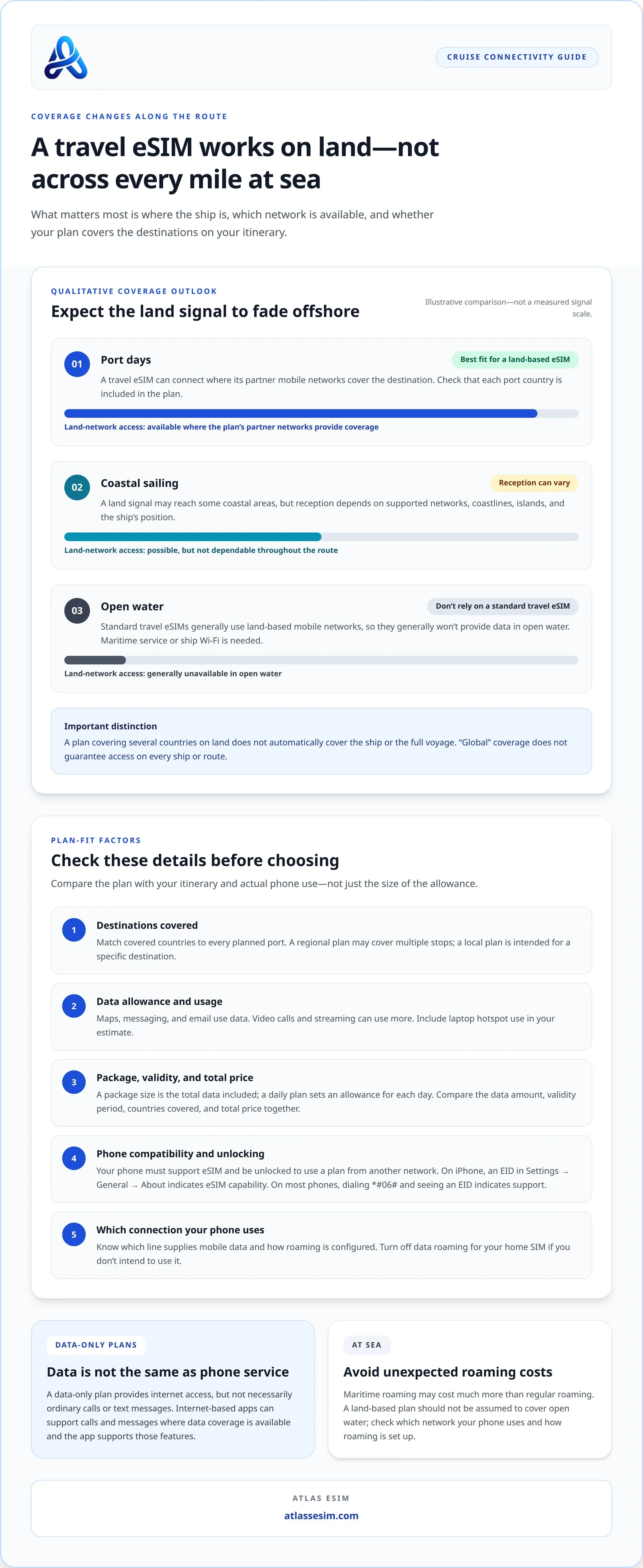
ESIM connectivity throughout a cruise
How does an eSIM work on an international cruise? It provides mobile data through a supported network, using a digital SIM profile instead of a removable SIM card. An eSIM for an international cruise can connect through land-based networks in covered destinations, but open-water service requires maritime connectivity or ship Wi-Fi.
Plan around the voyage’s stages: embarkation, port calls and sea days. A land-based data plan can serve destinations where its network partners provide coverage. Once the ship sails beyond those networks, the plan won’t provide a signal just because it remains installed on your phone.
Before departure, choose a plan that matches the countries on your itinerary and your expected use ashore. Maps, messaging and browsing in port use mobile data. An unlimited label doesn’t create coverage at sea, so check the plan’s terms and account for network availability. Along with mobile connectivity, remember to prepare country-specific essentials for your port visits; for travelers stopping in Georgia, E-COVER offers dedicated travel medical insurance.
At sea, use a connection intended for maritime coverage or the ship’s Wi-Fi. These are separate from a regular land-based eSIM. Cruise lines may offer onboard connectivity, but ship Wi-Fi and mobile data use different services. Knowing which connection your phone is using helps you avoid relying on the wrong one.
Prepare for the transition between ports and open water. Before boarding, install the eSIM and make sure its profile is ready for the countries you’ll visit. In port, mobile data can connect through a supported local network. During open-water sailing, use maritime service or ship Wi-Fi instead.
The practical takeaway: an eSIM for an international cruise may support several port destinations without covering the entire voyage. When comparing plans, distinguish country coverage from onboard coverage. This matters more than an unlimited label if you need data ashore and a separate connection at sea.
Atlas eSIM
Atlas eSIM helps travelers prepare mobile data for land-based destinations on an international cruise itinerary. Its Local eSIM data plans and Regional Plans can suit port visits, depending on the countries covered. Prices and data allowances are shown before checkout, making it easier to compare options with your expected use.
A travel eSIM connects through supported land networks, so it isn’t a substitute for maritime service or ship Wi-Fi during open-water days. Match the plan to the countries you’ll visit, then plan separately for sea-day connectivity.
If you’re planning data for port stops, contact Atlas eSIM to discuss the destinations on your itinerary.
Plan Your Next Connection
Before your sailing, decide which parts of your trip need mobile data and which connection you’ll use. This simple distinction can help you choose an eSIM for an international cruise that fits your time ashore, without mistaking port coverage for a promise of service at sea.
Atlas eSIM offers Local eSIM data plans and Regional Plans for travel across covered destinations. Start with your itinerary: the countries you’ll visit and how you use your phone can help you choose a plan for shore days. Keep onboard connectivity separate in your travel plan.
Ready to plan data for your destinations? Contact Atlas eSIM about cruise plans and discuss the options for your route. A clear plan for port days can make it easier to set off prepared and focus on the journey ahead.
Frequently Asked Questions
How can a provider help me avoid unexpected maritime roaming charges?
A provider can explain where a travel data plan applies and how it differs from maritime connectivity. A land-based eSIM won’t cover open water, so it isn’t a substitute for ship Wi-Fi or maritime service. To reduce accidental charges, set your phone to use the travel eSIM for mobile data and turn off data roaming on your home line while at sea.
Can I buy more data during my cruise?
Yes, Atlas eSIM supports topping up eSIMs through its app, so you can add data if your allowance runs low. You might use more mobile data than planned during port visits for maps, messages or browsing. A top-up won’t provide coverage where the plan’s network isn’t available, such as open water without maritime connectivity.
Can I keep my UK phone number active?
Yes. Atlas eSIM installs as a secondary digital line, so you can keep your UK home SIM active for calls and SMS while using the eSIM for mobile data. In your phone’s cellular settings, select the eSIM as the data line and manage the home line separately. At sea, maritime roaming on your home network may be costly.
How can a provider help activate an eSIM data plan for my device?
After checkout, Atlas eSIM sends an installable QR code, usually in under 60 seconds. Scan it with a compatible phone to add the eSIM as a secondary digital line. You can install it before travelling, then select it for mobile data when you reach a covered destination. Support is available 24/7 via WhatsApp or email for setup questions.
How is the service delivered?
Atlas eSIM delivers prepaid data plans online, with the price and data allowance shown before checkout. After payment, customers usually receive an installable QR code in under 60 seconds. The eSIM is added digitally to a compatible phone, so there’s no physical SIM delivery. You can keep your home SIM active for calls and SMS.
How can a provider check whether my device is compatible?
Atlas eSIM works with most iPhone XS and newer models, and many recent Android devices. Check our compatible devices list before you buy. You can also look for an EID in your phone’s settings, which indicates eSIM capability. On Android, an “Add eSIM” or “Add mobile plan” option in network or SIM settings is another useful sign.