

ESIM for Thailand for Your Trip
Find the right eSIM for Thailand: compare local and regional data plans, check phone compatibility, and choose coverage and data that suit your trip today.
You can buy an eSIM for Thailand online and arrange mobile data before your trip. The right choice depends on whether your phone supports eSIM and how much data you expect to use. A local plan suits a Thailand-only trip, while a regional plan can cover multiple countries.
Choosing between unlimited and capped data is easier when you consider how you’ll use your phone. Maps and messaging use data differently from frequent video calls, streaming, or remote work. Your itinerary matters too, especially if Thailand is one stop on a wider trip.
This guide explains how to buy an eSIM online, check device compatibility, and compare data plans. Use these practical details to find an option that fits your route and keeps you connected for directions, messaging, and other travel needs.
Key Takeaways
- Work out whether unlimited data fits your daily usage, and look beyond the headline allowance to how a plan handles high-speed data.
- Check your phone’s eSIM capability before you buy; the guide gives examples of compatible iPhone, Samsung Galaxy, and Google Pixel models.
- Understand what to look for in an online plan’s network details and how your location can affect the connection.
- Match a local or regional plan to the countries on your itinerary, then compare the data allowance shown for each option.
Table of Contents
Do I need an unlimited data plan for Thailand?
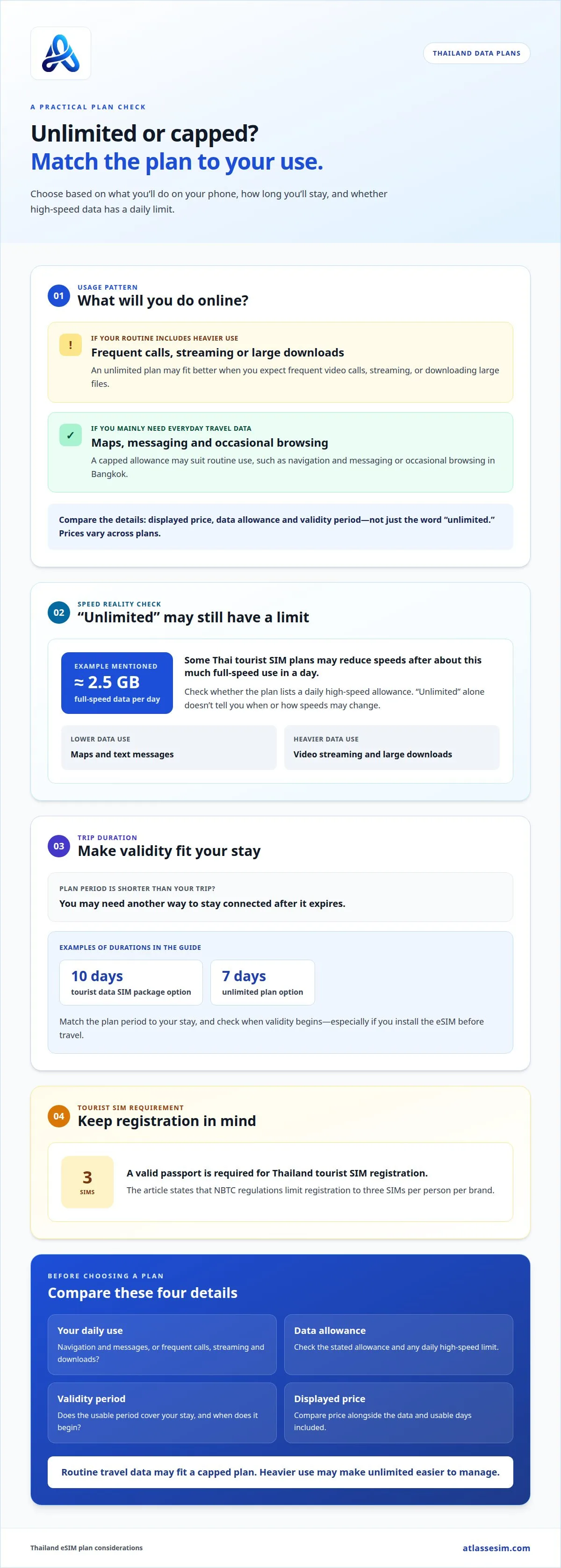
Not always. For a Thailand trip, choose an unlimited plan if you expect frequent video calls, streaming, or large downloads. For maps, messaging, and occasional browsing in Bangkok, a capped data plan may suit your routine. Compare the displayed price with the data allowance and validity period, not just the word “unlimited.” That makes it easier to judge what you’ll use before your plan expires.
Unlimited can still have a high-speed limit. Some Thai tourist SIM plans may reduce speeds after about 2.5 GB of full-speed use per day. Check whether a plan describes daily high-speed data, then consider what slower speeds mean for your travel: maps and text messages use less data than video streaming or downloading large files. “Unlimited” alone doesn’t explain how speed may change.
Validity matters as much as allowance. Thailand plans can have different durations; tourist data SIM packages include a 10-day option, and 7-day unlimited plans are also available. Match the plan period to your stay. A shorter trip may not need a longer validity period, while a stay that exceeds the plan’s expiry requires another way to stay connected. Check when validity begins, since that affects how much of the period you can use after you install the eSIM.
Thailand tourist SIM registration requires a valid passport. According to the National Broadcasting and Telecommunications Commission (NBTC), registration is limited to three SIMs per person per brand under its regulations. Keep this requirement in mind when comparing tourist SIM options with an eSIM for Thailand.
Before buying, estimate your daily use: navigation and messaging, video calls, streaming, and downloads. Then compare each data plan’s allowance, validity, and any daily high-speed limit. Prices vary across plans, so compare the amount of data and usable days included rather than treating the lowest displayed price as the best fit. If you mainly need routine travel data, a capped allowance may be enough; choose unlimited when heavier use makes a daily limit harder to manage.
Device compatibility
Start with your phone model: eSIM support depends on the device, not your destination. Compatible examples include iPhone XS or XR and newer, Samsung Galaxy S20+, and Google Pixel 3+. These examples help narrow your check, but model names can vary by region. Find your exact model in its settings or device information before choosing a Thailand package.
Then check whether your phone is carrier-unlocked. A carrier lock can restrict which mobile networks or eSIM profiles your device accepts, even if its hardware supports eSIM. Using a physical SIM does not confirm eSIM compatibility. Check both: your phone must support eSIM, and its carrier settings must allow another network’s profile.
Network compatibility affects where the service connects. A Thailand eSIM listing names dtac as its primary network and indicates two additional networks are available. That gives travelers network options, but the display name alone doesn’t explain coverage at every destination. Check the package’s network details against your route, especially if you plan to travel beyond Bangkok or visit several countries.
Tourist SIM packages and regular prepaid SIMs suit different travel patterns. A tourist package is designed around a trip, while regular prepaid service may suit ongoing local use. Compare validity and data allowance, and check whether calls or a phone number are included. A data-only plan won’t meet a need for local voice calls unless that feature is included.
Before buying, confirm that your phone supports eSIM and that the plan covers Thailand. Compare the stated coverage with your destinations and choose based on your route and data needs. A stay focused on Bangkok and a multi-country itinerary call for different plan considerations. Checking compatibility first helps avoid buying a plan your phone can’t use.
Can I buy an eSIM for Thailand online?
Yes. You can purchase a Thailand eSIM online before travel, then install it on a compatible phone. The plan listing should show its data allowance, validity, and supported mobile networks. For the Thailand plan described here, dtac is the primary network, and two additional networks are available. Check the listing’s network details before purchase so you know which options apply.
Coverage and connection speeds depend on the network available where you’re using your phone. Buildings, terrain, and local network conditions can affect signal strength. A plan naming dtac doesn’t mean every place has the same connection. AIS and dtac are network names you may see in Thailand plan information; compare the stated networks with your itinerary, including stops outside Bangkok.
To install an eSIM, connect your compatible iPhone or Android device to Wi-Fi and open its mobile-plan settings. Choose the option to add an eSIM, then scan the QR code and follow the on-screen steps. When you’re ready to connect, select the eSIM for mobile data. Menu names vary by device, so follow the prompts on your phone.
If the eSIM doesn’t connect, confirm it’s enabled for mobile data and that your phone shows a supported network. Toggle airplane mode, restart the device, and check the plan’s network details. If data runs out, the connection may stop until you add another data plan. Check the remaining allowance and validity in your plan information before relying on it for maps or messaging.
Installing an eSIM before arrival helps you prepare, but connecting still depends on your device and the local network. Your phone may show the eSIM as installed while mobile data is assigned to another line. Select the eSIM as your data line, then allow the phone to register on a supported network. If it still won’t connect, review the installation prompts and plan details.
Regional eSIM plans that include Thailand
A regional eSIM can suit a trip that crosses borders, such as a Thailand stop followed by another country. Instead of arranging a separate data plan for each destination, compare the regional plan’s country list with every stop on your itinerary. Coverage applies only in the countries included in that plan, so check the list before purchase. A global plan may cover a wider range of countries, but its included destinations still determine where it works.
The best eSIM for your trip is one that matches your route, data needs, and length of stay. Choose a Thailand-focused local plan for a stay in Thailand, or consider a regional option if you’ll continue to other covered destinations. Compare the countries included, data allowance, validity, and whether the plan offers unlimited data. Review the fair-use rules for unlimited plans before choosing.
Regional plans differ in the destinations they cover and how they provide data. Don’t assume a plan described as regional includes every nearby country. Read its country list and check that Thailand appears alongside your other stops. If you’ll spend most of your trip in Thailand, a local data plan may fit better than a wider regional or global package.
An eSIM is digital, so there’s no physical SIM card to carry or swap. After purchase, follow the supplied instructions to install it, then activate it according to the plan’s terms. You can prepare before you arrive, but check whether activation starts the plan’s validity immediately or on first connection. A QR code may be used for installation, depending on the purchase process.
Mobile data doesn’t automatically include a local phone number, calls, or SMS. Check these separately, since data-only plans are for internet use such as maps and messaging apps. For a multi-country trip, also confirm that the plan covers each destination. Choose a plan whose country coverage, data allowance, and validity match your itinerary.
Atlas eSIM
Atlas eSIM offers prepaid data plans for trips focused on Thailand and routes across multiple countries. Choose a local plan for a Thailand-focused itinerary or a regional plan for other covered destinations. Each plan displays its price and data allowance before checkout, so you can compare the details with your expected use.
After purchase, customers usually receive an installable QR code in under 60 seconds. Install the eSIM before travel, then follow its instructions to connect when you’re ready. If you’re weighing a local plan against a regional option for Thailand, contact Atlas eSIM to discuss your travel needs.
Make connectivity part of your trip plan
Plan for mobile data alongside your other first-day arrangements. Decide what you need your phone for, from checking directions to sharing updates with people at home. This makes choosing an eSIM for Thailand a practical part of trip planning, rather than a decision to leave until you arrive.
Atlas eSIM offers local and regional prepaid data plans for different travel routes. Choose the option that fits your destinations, then review its allowance and validity against your itinerary. You can install the eSIM before departure and start using data when you begin using it at your destination.
If you’d like help deciding which option fits your travel plans, contact Atlas eSIM for help. Make your connection plan, pack your essentials, and set off with one less travel task on your mind.
Frequently Asked Questions
When should I install my eSIM?
Install the eSIM before departure while you have an internet connection, then follow the setup instructions. You can prepare the profile ahead of your trip and start using data when you begin using it at your destination. Keep the installation details accessible until setup is complete, and avoid deleting the eSIM profile while troubleshooting.
Are eSIMs available in Thailand?
Yes. You can buy a Thailand eSIM online and install it on a compatible device. It provides mobile data through supported local networks for services such as maps and messaging. Before buying, confirm that your device supports eSIM and that the plan covers Thailand. Online purchase lets you arrange connectivity before you travel.
Are there any contracts like those from traditional eSIM carriers?
Travel eSIM data plans are typically prepaid: you select a destination or region, choose a plan, and pay before using its data. The allowance and price appear before checkout, helping you understand the purchase terms upfront. This differs from a traditional carrier arrangement billed over time. Review the plan’s validity and data conditions so they fit your trip rather than an ongoing monthly need.
Is eSIM secure?
An eSIM is a digital mobile plan installed on your device, so protect it as you would other account access. Use your phone’s screen lock, keep the installation QR code private, and install the profile using the supplied instructions. Don’t share account or payment details in response to unexpected messages. You can keep your home SIM active for calls and SMS while managing both lines in your phone’s mobile settings.
How much does a Thailand travel eSIM cost by data amount and validity period?
There isn’t one fixed price for every Thailand travel eSIM. The plan’s data allowance and validity help determine which option suits you, with capped and unlimited plans for different usage needs. Atlas eSIM displays each plan’s price and allowance before checkout, and plans are prepaid. Compare the data allowance with how long you’ll need it.
Which Thailand eSIM providers offer the best coverage and speeds?
No single provider is best for every itinerary or use. Compare the networks named in each plan, then consider where you’ll travel and whether you’ll need data in cities, rural areas, or both. Coverage and connection speeds depend on local network conditions and your location. For a Thailand plan, check its stated carrier options and choose one that fits your destinations and daily activities.