

ESIM for Spain: How It Works, Coverage and Activation
Discover how an eSIM for Spain works, including coverage, compatibility, activation timing, data planning, and using your usual number while travelling.
Set up your Spain connection before you travel without swapping out your usual SIM. An eSIM for Spain is a digital mobile plan installed on a compatible phone. You’ll need internet access to install it, then you can use it for mobile data during your trip.
It’s reasonable to want clear details before relying on a new setup abroad. Choose a data allowance that suits your plans, and time your activation so the plan is ready when you need it.
This guide explains how Spain eSIMs work, when to install and activate one, and how long your data may last for different travel habits. It also covers coverage across mainland Spain and the islands, phone compatibility, and what to expect if you want to keep using your usual number for calls or messages.
Key Takeaways
- Choose a data allowance around how you’ll use maps, messaging, social media, and online work during your trip.
- Plan installation and activation separately so your data plan is ready at the right point in your journey.
- Understand how coverage can vary between mainland Spain, the islands, and different locations.
- Learn what to check for phone compatibility and how an eSIM can fit alongside your usual SIM.
Table of Contents
Data plan validity and activation timing
Match the plan’s validity to your travel dates, then install it while you have internet access. Your trip length, daily data use, and need for calls or texts all affect which setup fits.
Plan Validity Periods
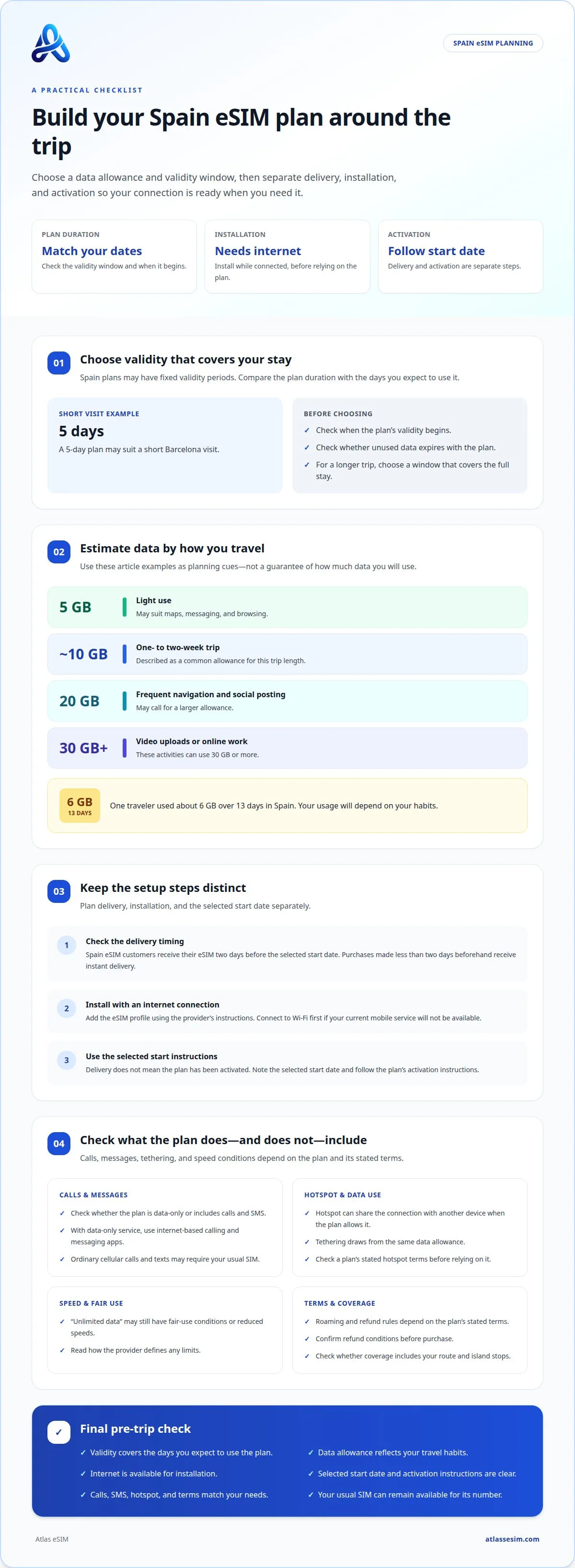
Spain plans can use fixed validity periods, so compare the plan’s duration with the days you expect to use it. For example, a 5-day plan may suit a short Barcelona visit, while a longer trip needs a window that covers the full stay. Check when validity begins and whether unused data expires with the plan.
Activation Timing
Install the eSIM before travel using an internet connection, then follow the plan’s start instructions. Spain eSIM customers receive their eSIM two days before the selected start date; purchases made less than two days before that date receive instant delivery. Delivery and activation are different steps, so note the selected start date.
Estimate data by habit, not just by trip length. A traveler used about 6 GB over 13 days in Spain; 5 GB may suit light maps, messaging, and browsing. Around 10 GB is a common allowance for a one- to two-week trip, while frequent navigation and social posting may call for 20 GB. Uploading videos or working online can use 30 GB or more.
Check whether your plan is data-only or includes calls and SMS. With a data-only plan, use internet-based calling and messaging apps; ordinary cellular calls and texts may require your usual SIM. Hotspot use can share data with another device, but tethering draws on the plan’s allowance too.
Roaming, throttling, and refund rules depend on the plan’s stated terms. “Unlimited data” can still come with fair-use conditions or reduced speeds, so read how the provider defines those limits. Confirm the refund conditions before purchase, and check whether Spain coverage includes your route to the Balearic Islands.
Mobile network coverage across Spain and its islands
Coverage depends on the local mobile network your eSIM uses, not just Spain’s outline on a coverage map. A provider may work with several networks, and travel eSIM companies can offer access to three or four network providers in one country. The available network and speeds can vary by provider and location, so service in central Barcelona may differ from a remote road or coastal area.
Some Spain eSIM providers claim coverage across 99% of Spain, including the Balearic and Canary Islands. Treat that figure as a provider’s coverage claim, not a promise of signal in every building, mountain pass, or stretch of road. Check whether your route and island stops fall within the plan’s stated coverage, especially when travelling beyond major towns.
In areas with 5G coverage, a Spain eSIM may offer speeds up to 300 Mbps. That maximum depends on the local network and conditions; a 5G symbol does not mean every location will reach that speed. For a road trip, expect connectivity to change as you move between towns and rural areas. Your phone may connect automatically to an available supported network, but the network options depend on the eSIM plan.
Can you use a Spain eSIM for hotspot or tethering? Hotspot is available on most Atlas eSIM plans, and availability is shown on each plan page before checkout. Tethering shares the eSIM’s mobile data with another device, such as a laptop, so both devices draw from the same allowance.
A regional plan can suit a route that crosses Spain’s borders into other parts of Europe, while a local plan focuses on Spain. Before downloading the eSIM from its QR code, review the countries covered and the supported network details. For multi-country travel, explore regional eSIM plans alongside your route.
ESIM for Spain, how does it work?
An eSIM is a digital profile installed on a compatible device, rather than a physical SIM card inserted into a tray. For a Spain trip, choose a plan, install its profile with internet access, and select it for mobile data after you arrive. Your usual SIM can remain in a Dual SIM-compatible phone.
Compatibility comes first. Google Pixel 3 and later are among the phones listed as eSIM-compatible, but model support can vary by device version and market. Check the exact phone model’s eSIM settings or specifications before purchase. Tablets can use an eSIM only when that specific tablet supports eSIM installation and mobile connectivity.
Compare Spain plans by the details that shape your trip: data allowance, validity period, covered locations, supported network, and hotspot terms. A short Barcelona stay may call for a different validity window than a longer road trip. Prices also differ between plans, so compare the displayed cost with the data and duration rather than choosing on price alone.
Plan type matters too. A local plan is designed for a particular destination, while a regional plan can suit travel across several countries. If your route crosses borders, compare the plan’s listed destinations and validity. If you need a connection for work, check the data allowance and whether hotspot is available on the plan.
Installation usually follows a simple sequence: purchase a prepaid plan, connect to the internet, then add the eSIM profile using the installation instructions. Keep your home SIM active if you still need its number for ordinary calls or texts. A data-only eSIM supports internet activities, while regular calls and SMS depend on your other SIM and phone settings. The eSIM installs as a secondary digital line, so you can use mobile data without removing your usual SIM.
ESIM activation, compatibility, and phone-number use
Buying, installing, and activating an eSIM are separate steps. Keep an internet connection available for installation, then activate the profile when you’re ready to use mobile data in Spain.
ESIM Purchase and Installation
After purchase, follow the provider’s instructions to add the eSIM to your phone. Installation needs internet access, so connect to Wi-Fi before starting if your current mobile service won’t be available. Spain eSIM customers receive their eSIM two days before the selected start date; purchases made less than two days beforehand receive instant delivery. Save the installation details until setup is complete.
Activation Steps
Once installed, open your phone’s mobile or cellular settings and select the travel eSIM for data. Follow the plan’s instructions, and enable data roaming for that line if required. Keep your home SIM selected for calls or texts if you still need its number. If data doesn’t connect, confirm the eSIM is enabled and selected for mobile data.
Device Compatibility
The phone must support eSIM and be able to install an additional mobile profile. Google Pixel 3 and later are listed among compatible phones, but support varies by exact model. On a Dual SIM-compatible device, the eSIM can work alongside your physical SIM. A data-only eSIM doesn’t provide a regular phone number for cellular calls or SMS; use WhatsApp or similar apps over internet instead.
For setup, choose a Spain eSIM data plan that matches your trip, then install it before you need mobile data.
Atlas eSIM
Atlas eSIM offers local and regional prepaid data plans for travel. Choose a local plan for a trip focused on one destination or a regional plan for travel across countries, then consider your route, expected data use, and plan validity. Prices and data allowances are shown before checkout, so you can see what a plan includes before choosing.
For a vacation or road trip, an eSIM can keep mobile data separate from the number on your home SIM. That’s useful for maps, messaging, and travel updates while keeping your home SIM active for calls or texts, depending on your phone settings.
For a plan that fits your Spain itinerary, contact Atlas eSIM.
Get your Spain connection ready for the trip
Before you travel, decide where you’ll need mobile data and what you’ll use it for. A city break and a cross-country drive can call for different coverage priorities, so match your plan to your route and everyday needs. With an eSIM for Spain, you can prepare your digital connection before departure and keep your home SIM active.
Atlas eSIM offers Local eSIM data plans for trips focused on Spain, as well as Regional Plans for itineraries across more than one country. Choose the option that fits your travel plans, then review its data allowance and validity before installing it.
Ready to take the next step? Contact Atlas eSIM to discuss your travel connectivity needs. Set up the right plan for your journey and head off with one less detail to manage.
Frequently Asked Questions
When should I install my eSIM?
Install your eSIM before the trip while you have a reliable internet connection. That way, you can complete setup without relying on airport or hotel Wi-Fi after landing. Installation and plan activation can be separate, so follow the plan’s start instructions to avoid using validity earlier than intended. Keep the setup instructions accessible in case you need to review your phone’s mobile settings.
What are the best eSIM providers for Spain?
The right plan depends on your route, data needs, validity, and the destinations it covers. For a trip focused on one destination, Atlas eSIM offers prepaid local data plans; regional plans can suit itineraries across countries. Compare the data allowance and validity shown for each plan, and consider whether its destinations match your full itinerary.
How much does a Spain eSIM cost for different data amounts and trip lengths?
There isn’t one cost for every data allowance or trip length. The total depends on the specific prepaid plan and its included data and validity. Atlas eSIM displays the price and data allowance before checkout, so compare those details for your trip. A short city break and a longer journey may need different plan durations and allowances.
Which Spain eSIM plans include unlimited data, and what are their fair-use limits?
Unlimited Data plans are available, but “unlimited” does not mean every plan has identical terms. Atlas eSIM presents the applicable fair-use rules upfront for its Unlimited Data options. Read the rules for the specific plan before purchase, especially if you expect heavy use, such as frequent video uploads or working online. Use those conditions to guide your choice.
Does a Spain eSIM include a local phone number, calls, or SMS?
Atlas eSIM sells prepaid data plans, so plan to use internet-based calls and messages rather than assuming a local phone number is included. You can keep your home SIM active as a secondary line for calls and SMS while using the eSIM for data. For example, WhatsApp calls and messages work over an internet connection, subject to the app and your settings.
Which mobile networks do travel eSIMs use in Spain, and how is coverage outside major cities?
Travel eSIM providers can offer access to three or four network providers in Spain, with coverage and speeds varying between networks. Outside cities, the signal you receive depends on the local network and where you’re travelling. A route through smaller towns or rural areas may have different connectivity from central Barcelona, so consider your whole itinerary rather than city coverage alone.