

ESIM for South America prices, coverage and routes
Compare eSIM South America prices, coverage and data plans. Learn to match regional or local options to your route and travel needs before you travel abroad.
A regional eSIM can simplify a multi-country South America trip, but its coverage must match your route. Atlas eSIM offers local and regional prepaid data plans, so you can compare options for individual destinations or travel across included countries. Install the eSIM before departure, then use mobile data as you travel.
One plan can keep maps, messaging, and other mobile data in reach without swapping physical SIM cards. Look beyond the plan name: check which countries are covered, the data allowance, validity, and any fair-use rules. These details show whether a plan suits your itinerary and expected use.
This guide explains how to choose an eSIM for South America and what to compare before you travel. You’ll learn how to assess coverage, plan types, and common itineraries, and how local and regional eSIM data plans can fit different trips. Choose based on where you’re going and how you expect to use data, not just the headline allowance.
Key Takeaways
- Match regional coverage to every country on your itinerary; a plan covering several destinations may still exclude places on your route.
- Estimate your data needs around maps, messaging, and social apps, then compare allowances and any speed limits.
- Compare plans by usable data, validity, and route fit rather than headline price alone.
- For multi-country travel, weigh one regional plan against local plans for individual stops, especially when your route crosses coverage gaps.
Table of Contents
How can a provider help you get an eSIM for Latin America?
A provider matches your route, phone compatibility, and data habits to a suitable travel eSIM. For South America, that means checking country coverage and explaining what each plan’s allowance and validity include.
Data Allowances and Plan Durations
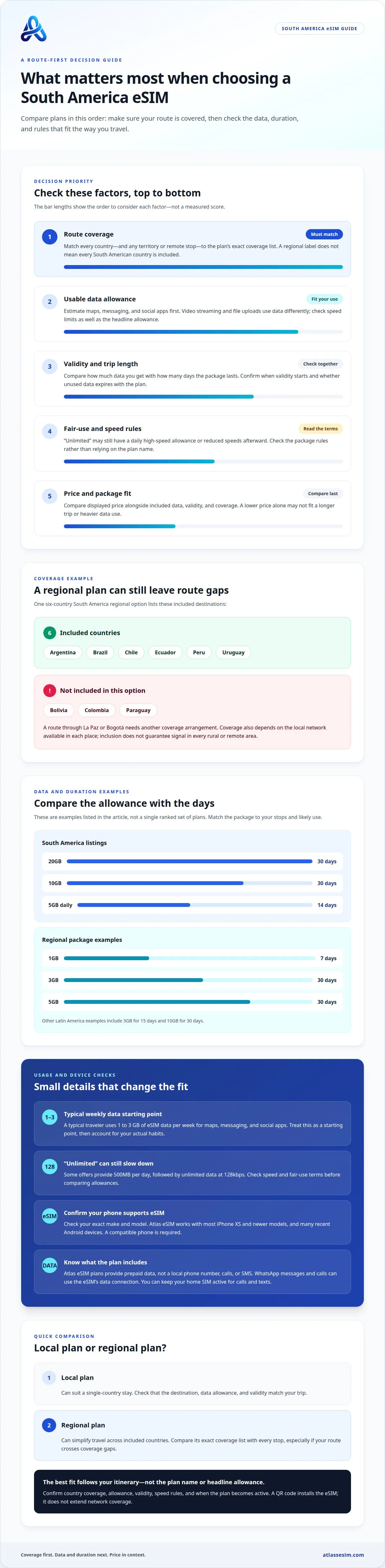
Share your trip length and typical use: maps, messaging, social apps, or video calls. A typical traveler uses 1 to 3 GB of eSIM data per week for maps, messaging, and social apps. A provider can use that as a starting point, then compare plan allowances and durations against your itinerary. For several countries, ask how the Latin America eSIM handles data across its listed network coverage. “Unlimited” plans can still have speed limits, so review the terms alongside the allowance.
Phone Compatibility Checks Before Choosing a South America eSIM
Check your phone’s exact make and model against the compatible devices list before you buy. Atlas eSIM works with most iPhone XS and newer models, and many recent Android devices. It installs as a secondary digital line, so you can keep your home SIM active for calls and SMS. Your phone must support eSIM.
Coverage limits follow the countries and networks listed for the plan. Validity follows its stated duration, while refund terms depend on the provider’s policy and activation conditions. Before purchase, have the provider explain when validity begins and which refund conditions apply.
For data planning, separate everyday use from higher-data activities. Maps and messaging generally use data differently from frequent video streaming or file uploads. Data-saving mode, lower video quality, and limiting background app use can help conserve your allowance. These settings don’t expand a plan’s coverage or data allowance.
Atlas eSIM installs as a secondary digital line on a compatible phone, and you can keep your home SIM active for calls and SMS. Set the eSIM as your mobile data line and keep your home line active if you want to use it for calls or texts. Atlas eSIM plans provide prepaid data, not a local phone number, calls, or SMS.
Country coverage and connectivity limitations
A regional plan covers the countries listed for that plan, not automatically every destination in South America. Compare each stop on your route with the plan’s coverage details before you buy.
Included Countries and Providers
As of November 2026, one six-country South America regional option covers Argentina, Brazil, Chile, Ecuador, Peru, and Uruguay. It excludes Bolivia, Colombia, and Paraguay, so a route through La Paz or Bogotá needs another coverage arrangement. Providers package different country groups; the regional label alone doesn’t tell you which countries are included. Compare the exact country list with your stops before choosing.
Coverage for Routes and Remote Areas
A provider can match listed countries to your itinerary, including border crossings and island or overseas territories. Coverage depends on the local network available in each place, so a country’s inclusion doesn’t mean every remote road or rural area has signal. For example, a route between major cities may have different connectivity from a remote wilderness stop.
Check each destination against the plan’s listed coverage, including any territory on your route. WhatsApp messages and calls use mobile data, but a QR code only installs the eSIM and doesn’t extend its network coverage. Mobile data depends on network availability where you’re traveling.
Do South America eSIMs include a local phone number, SMS, or calls? Atlas eSIM offers prepaid data plans, not a local number, calls, or SMS. WhatsApp calls and messages can use the eSIM’s data connection.
For a multi-country trip, give the provider your stops and route, then compare each country against the plan’s coverage list. A local plan can suit a single-country stay, while regional coverage can simplify travel across included countries. Browse regional coverage options to compare coverage against your route.
South America eSIM plan prices
Compare each plan’s price, data allowance, and validity. A package with less data may not suit a longer trip or heavier internet use.
Prices by Data Allowance and Validity
Check the data amount and expiry period together, not as separate details. South America listings include examples with 20GB for 30 days, 10GB for 30 days, and 5GB daily for 14 days. Those allowances serve different travel patterns, so select a package around your trip length and likely mobile use.
Prices vary with the allowance, duration, and included coverage. Compare the amount shown at purchase with the data and days provided. Also look for speed limits after a daily or total allowance. A data plan that slows after its high-speed data runs out works differently from one that keeps full speeds.
Regional Plan Prices and Durations
Regional packages combine access across their listed countries, while local plans focus on individual destinations. South America examples include 1GB for 7 days, 3GB for 30 days, and 5GB for 30 days. Latin America packages also include examples with 3GB for 15 days and 10GB for 30 days. Match both the country list and duration to your itinerary.
Before you download a plan, compare its displayed price, validity, and data rules. Roaming alternatives can have separate charges and conditions, so assess them against the eSIM package rather than comparing price alone. Check when validity starts and whether unused data expires with the plan.
Which South America eSIM offers unlimited data or local phone calls? Some offers provide 500MB per day, followed by unlimited data at 128kbps. Unlimited data doesn’t necessarily include calls; check the package’s listed services before selecting it.
Plan comparisons for common travel routes
Start with your route, not the package label. List every destination and stop, then match each country to a plan’s coverage. For example, a route through Argentina and Chile requires a plan that includes both countries. A route-first comparison helps you decide whether an eSIM for South America fits your trip.
For a trip focused on one destination, compare local plans for that country. If you’re visiting several destinations, compare regional plans with the relevant local plans. A regional option can simplify managing data across included countries, while a local plan may suit a trip concentrated in one destination. Check each plan’s country list.
Next, compare trip length with plan duration. A package valid for 30 days may suit a month-long itinerary, while a shorter validity period could expire before the return journey. Match the allowance and expiry period to the full travel schedule, including arrival and departure days. That gives an eSIM for South America a better chance of fitting your actual travel dates.
Installation windows also matter. Some plans state that installation must take place within 90 days after purchase. That window is separate from plan validity: the first sets a deadline for installing the eSIM, while the second determines how long its service lasts. Follow the plan’s instructions for both dates.
To stay connected on arrival, arrange installation before travel when the plan permits it. Keep the instructions available on another device, such as a laptop, if your phone displays the QR code. Avoid deleting an installed eSIM while changing destinations; it may be needed for later legs covered by the plan.
Compare route options in this order: countries covered, data allowance, validity, then plan details. For a multi-stop trip, match every destination to the country list and review the plan’s terms. That makes coverage gaps easier to spot before you buy.
Ready to match a plan to your destinations? Compare plans for your travel route against your installation timing.
Atlas eSIM
Atlas eSIM helps travelers choose between local eSIM data plans and Regional Plans for South America trips. These options suit different itineraries: local plans focus on individual destinations, while regional plans can cover travel across their included countries. The right fit depends on your route, data allowance, and plan validity.
Each plan displays its price and data allowance upfront, making the main details easier to compare. Customers usually receive an installable QR code in under 60 seconds. Support is available 24/7 through WhatsApp or email for questions about choosing or installing a plan.
If you’re ready to discuss your travel needs, contact Atlas eSIM.
Make your connectivity choice part of trip planning
Before departure, turn your route into a practical connectivity plan. Note where you’ll need maps, messaging, or other mobile data, then consider how your usage may change between travel days and longer stays. Planning ahead makes choosing an eSIM for South America more straightforward, even when your trip crosses borders.
Keep your priorities clear: destinations first, then data needs and plan details. If your route changes, use the updated itinerary to reassess which plan type fits. Atlas eSIM offers local eSIM data plans and Regional Plans for different itineraries. Compare the plan’s country list and data allowance with the way you expect to travel.
Ready to discuss the right fit for your itinerary? Contact Atlas eSIM about your trip, and take the next step toward travelling prepared.
Frequently Asked Questions
When should I install my eSIM?
Install it before departure while you have a stable internet connection. For a South America eSIM, check whether installation has a purchase deadline, since some plans require installation within 90 days after purchase. Installation and plan use can follow different timing rules. Read the plan instructions to understand when validity begins, and prepare before travel rather than relying on airport Wi-Fi.
Which South American countries are covered by regional eSIM plans?
Coverage depends on the countries listed for each regional plan. As of November 2026, one six-country regional option covers Argentina, Brazil, Chile, Ecuador, Peru, and Uruguay, but excludes Bolivia, Colombia, and Paraguay. For a trip through several destinations, map each stop to the plan’s country list. A country’s inclusion also doesn’t mean every remote area has network coverage.
What are the best eSIM providers for travel in South America?
The right eSIM depends on your route, phone compatibility, and data needs. Atlas eSIM offers local eSIM data plans and Regional Plans. Match the plan’s included countries to your itinerary, then review its data allowance and details. A traveler staying in one destination may prefer a local plan, while someone crossing borders can compare regional options.
How much do South America eSIM plans cost, and how much data do they include?
Plans vary in price, data allowance, validity, and coverage. Compare the total data with how long the plan lasts, then consider whether you’ll use video calls or uploads, or mostly maps and messaging. Atlas eSIM shows prepaid plan prices and data allowances before checkout, helping you compare what each option includes.
Can one eSIM work across multiple South American countries without roaming fees?
Yes, one regional eSIM can work across multiple countries when the plan includes those destinations. It connects through supported local networks, so service can vary by location. Atlas eSIM sells prepaid data plans, not traditional roaming plans. Match every stop to the plan’s country list and consider that coverage may vary in remote areas.
How can a provider help install and activate an eSIM for travel in South America on iPhone or Android?
A provider can help clarify device compatibility and guide you through the installation instructions. Atlas eSIM works with most iPhone XS and newer models, and many recent Android devices; check the compatible devices list before buying. After purchase, scan the QR code from checkout or My eSIMs and follow your phone’s prompts. Keep the installation instructions accessible during setup.