

Choose an Asia eSIM for reliable travel data and easy setup
Find the best eSIM for Asia with practical data estimates, coverage tips, and simple setup advice to stay connected across your trip before you depart today.
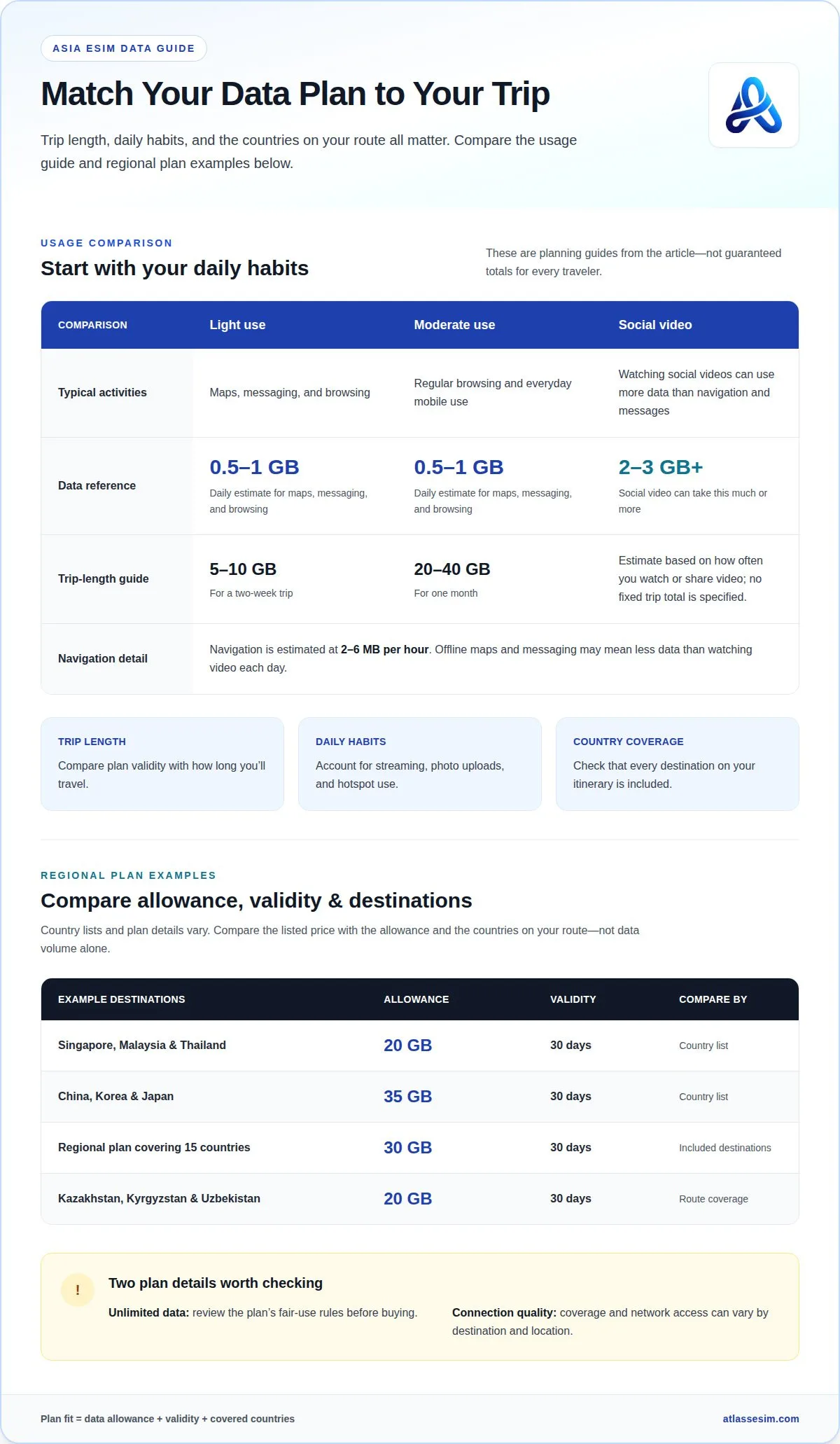
The best eSIM for Asia isn’t automatically the one with the biggest data allowance. For light use, such as maps, messaging, and browsing, consider 5-10 GB for a two-week trip; for moderate use over a month, consider 20-40 GB. Your route and habits matter: watching social videos can use more data than everyday navigation and messages.
It makes sense to want reliable internet without adding a complicated setup to your travel day. An eSIM can be prepared before you leave, so you can focus on getting connected when you arrive. This guide explains what to look for in an Asia plan, how to estimate your data needs, what can affect coverage, and how to buy and install an eSIM before your trip.
Key Takeaways
- Match your data allowance to trip length and habits, especially if you plan to stream or share videos.
- Check that your phone supports eSIM and isn’t carrier-locked before choosing a plan.
- Match a regional plan’s included countries and network coverage to your itinerary.
- Buy and install your eSIM before departure so setup is ready when you arrive.
Table of Contents
How much data do I need for a trip to Asia?
To choose the best eSIM for Asia, match the data allowance and plan validity to your trip length and mobile habits. Check that every country on your itinerary is included, especially if you’ll cross borders.
Trip-Length Data Recommendations
For light use during a two-week trip, consider 5-10 GB. For moderate use over one month, consider 20-40 GB. Daily habits can change that estimate: maps, messaging, and browsing use about 0.5-1 GB daily, while social video can take 2-3 GB or more. Navigation uses an estimated 2-6 MB per hour.
Choose your best eSIM for Asia by estimating how often you’ll stream, upload photos, or use a hotspot. A traveler relying on offline maps and messaging may need less data than someone watching video each day.
Regional Plan Prices and Allowances
Regional plans vary in price, allowance, validity, and country coverage. For example, a plan covering Singapore, Malaysia, and Thailand offers 20 GB for 30 days; another covering China, Korea, and Japan offers 35 GB for 30 days. Compare the listed price with the allowance and the countries on your route, rather than judging by data volume alone.
An Unlimited Data plan can suit heavier mobile use, but review its fair-use rules before you buy. A capped data plan may be a better fit if you prefer a defined allowance. Compare the plan’s validity with your trip length, and consider how you’ll manage data if your usage changes.
A traveler reported receiving 4G speeds throughout a trip to Japan and China. That experience provides an example, not a guarantee of identical reception in every location.
| Plan option | Example allowance | Useful for |
|---|---|---|
| Light use | 5-10 GB for two weeks | Maps and messages |
| Moderate use | 20-40 GB for one month | Regular browsing |
| Regional plan | 20 GB or 35 GB for 30 days | Multi-country travel |
Choose a plan by matching your trip length and daily data use with its validity, covered countries, and data allowance.
Why get an eSIM for Asia?
An eSIM provides mobile data without removing your home SIM. A local plan for one country isn’t automatically cheaper or faster than a regional plan. Compare the prices and data allowances shown before checkout, and remember that connection quality can vary by destination and network.
Start with device compatibility. Dial *#06# on your phone; an EID number indicates eSIM support. A carrier-locked phone may still prevent activation, so eSIM capability alone doesn’t guarantee that a plan will work. Before travel, review the phone’s SIM settings and confirm it can use an eSIM from another provider.
Most travel eSIMs provide data rather than a local phone number. An eSIM installs as a secondary digital line, so you can keep your home SIM active for calls and SMS. Select the eSIM for mobile data in your phone settings, and choose which line to use for calls and messages.
Compare providers by destination coverage, data allowance, validity, and the price shown for each plan. For example, a Vietnam plan offers 30 GB for 30 days; a regional plan may suit an itinerary crossing several countries. Check the included destinations and compare the allowance against your expected use, rather than choosing by the word “regional” alone.
Major provider options differ in the networks they use, the countries included, and how much data they provide. A local plan focuses on one destination, while an Asia regional plan can cover multiple stops under one plan. For a single-country stay, compare local and regional options by coverage, allowance, and validity. For a multi-country route, compare each provider’s country list against your itinerary. Explore regional eSIM data plans if one plan for several destinations fits your route.
Is mobile internet in Asia reliable for travel?
4G covers over 90% of the population across much of Asia. For a travel eSIM, reliability still depends on the network and coverage in each destination.
Regional Asia eSIM Coverage
A regional Asia eSIM plan can cover several countries with one data allowance. For example, one plan covers 15 countries and offers 30 GB for 30 days. Another covers Kazakhstan, Kyrgyzstan, and Uzbekistan, with 20 GB for 30 days. These examples show why country counts and included destinations matter as much as the label “Asia.”
Country-Wide eSIM Coverage
A local plan is designed for one destination, while a regional plan covers multiple included countries. For a stay focused on Japan, compare plans that include Japan. If your itinerary also includes another country, check whether it’s covered by the same regional plan to avoid managing separate plans.
Multi-Country Itinerary Connectivity
For a route through several countries, list every stop before choosing an eSIM plan. Match that list against the plan’s covered countries, then compare its allowance, validity, and supported networks. A Central Asia itinerary through Kazakhstan, Kyrgyzstan, and Uzbekistan aligns with the example regional plan covering those three destinations.
Coverage in a country doesn’t guarantee the same connection everywhere. Network access can vary by destination and location, so review the plan’s country coverage and supported networks for each stop. This is particularly useful if your itinerary includes several countries or places beyond major cities.
Use this sequence to narrow the options: confirm every country is covered, review the networks available there, then choose an allowance and validity that fit your route. A plan covering 15 countries may suit a wider itinerary, while a three-country Central Asia plan is more specific. Both make country coverage a practical comparison point, not a promise of the same connectivity at every stop.
Buying and installing an eSIM before travel
Set up your data plan before departure, while you have dependable internet and time to follow the instructions. You can install the eSIM before your trip, then select it for mobile data when you’re ready to connect at your destination.
- Choose the right plan. Match its country list to your itinerary, such as Singapore alone or a route through several destinations. Compare the data allowance and validity with your travel dates. Check that your phone supports eSIM and can use a plan from another provider.
- Purchase and save the installation details. After purchase, keep the QR code or installation instructions accessible on another screen or device. Customers usually receive an installable QR code in under 60 seconds. Saving it before travel avoids relying on airport Wi-Fi to retrieve it.
- Install the eSIM. Open your phone’s mobile or SIM settings and follow the plan’s installation instructions. If you scan a QR code, display it on a separate device. Label the new line “Asia data” or another clear name, so you can identify it beside your home SIM.
- Set your data line on arrival. In SIM settings, select the travel eSIM for mobile data and leave your home SIM configured for its intended use. Follow the plan’s activation instructions. This keeps the choice deliberate instead of relying on automatic line selection.
Before leaving, confirm the eSIM appears in settings and keep the QR code available until setup is complete. If installation instructions arrive through WhatsApp or email, save them somewhere accessible offline. Don’t delete the eSIM profile while troubleshooting; first review the plan’s setup steps and the device’s selected data line.
Unlike swapping SIM cards, eSIM setup adds a digital line to a compatible phone. For a multi-country trip, choose a plan that includes each destination before installation. Choose an Asia travel data plan that fits your route and prepare it before departure.
Atlas eSIM
Atlas eSIM offers Local eSIM data plans and Regional Plans for travelers heading to Asia. A local plan can suit a stay in one country, while a regional plan may fit a route through multiple included destinations. Compare the plan’s country coverage, data allowance, and validity with your itinerary and expected use.
These prepaid plans let you prepare mobile data before departure without swapping a physical SIM card. The eSIM installs as a secondary digital line, so you can keep your home SIM active for calls and SMS. Choose a local or regional plan based on the countries on your route.
Contact Atlas eSIM to discuss which plan type fits your Asia itinerary.
Make connectivity part of your trip plan
Your route is more than a list of places to visit. It also shapes how you stay connected between them. Treat mobile data as one of your travel essentials, alongside the details you organize before departure, and choose an option that fits the way you’ll move through Asia.
The best eSIM for Asia is the one that fits your itinerary and keeps setup straightforward. Atlas eSIM offers local and regional prepaid data plans for single-country stays and travel across included destinations. Compare the coverage and data allowance with your route, then select the plan that suits your trip.
Contact Atlas eSIM for help with choosing an option for your Asia travel plans. A little preparation now can leave more room to enjoy the journey ahead.
Frequently Asked Questions
How do eSIMs benefit you while traveling?
An eSIM installs as a secondary digital line, so you can keep your home SIM active for calls and SMS while using the travel eSIM for mobile data. Check that your phone is compatible before buying: Atlas eSIM works with most iPhone XS and newer models and many recent Android devices. Check the compatible devices list before you buy.
What are the best eSIM providers for travel in Asia?
The right provider is the one whose plan matches your destinations, data needs, and travel dates. Compare the included countries, supported networks, allowance, validity, and any high-speed data limits. Atlas eSIM offers Local eSIM data plans and Regional Plans, with plan prices and data allowances shown before checkout. That makes it easier to assess the plan details before you purchase.
Which eSIM plans cover the most Asian countries?
Look for plans that state their included countries clearly, then count how many match your itinerary. One regional plan example covers 15 countries, while another is limited to Kazakhstan, Kyrgyzstan, and Uzbekistan. A higher country count can help on a wide-ranging route, but it only helps if the plan includes every destination where you need mobile data.
How much do Asia regional eSIM data plans cost?
Across the market, Asia travel plans typically range from $5.1 to $36, with a median of about $19. This aggregate reflects 36 price samples from 6 sources, collected on November 6, 2026, and valid until December 6, 2026. Individual plan costs vary with the data allowance, validity period, and countries included. Atlas eSIM displays its plan price before checkout.
How much data do popular Asia eSIM plans include, and how long do they last?
Examples include a regional plan with 20 GB for 30 days across Singapore, Malaysia, and Thailand, and another with 35 GB for 30 days across China, Korea, and Japan. These illustrate how allowances and destination lists vary. Compare the plan’s validity with your dates, and make sure its covered countries match your stops before choosing.
Which Asia eSIM offers the best value for light, moderate, or heavy data use?
For light use, consider 5-10 GB for a two-week trip; moderate use may call for 20-40 GB over a month. Heavy social-video use can consume 2-3 GB or more daily, so compare unlimited plans’ high-speed allowances and fair-use terms. A fixed-data plan with top-ups can suit travelers who prefer a defined allowance and refill option.