

Choose a digital nomad eSIM by coverage and plan
Find the best eSIM for digital nomads by comparing route coverage, data, price, and validity. Learn to choose local or regional plans for remote work.
The cheapest eSIM isn’t automatically the best fit for a digital nomad. The best eSIM for digital nomads covers the countries on your route and provides enough data for how you work and travel. A plan suited to one destination may be less practical for a multi-country stay.
Compare coverage, price, data allowance and validity before choosing. The right plan can help you stay connected for maps, messages and remote work without swapping a physical SIM as you travel between destinations.
This guide explains how to compare local and regional eSIM plans, what to check in coverage and pricing, and how eSIMs work with compatible phones. You’ll also learn why they can suit flexible travel and how to choose a plan for your itinerary and everyday data needs.
Key Takeaways
- Match plan coverage to your route, then compare data allowance and validity to find a practical fit.
- Consider how your workday uses data, and understand any fair-use limits before choosing a plan.
- Confirm your phone supports eSIM so you can use a travel data plan without swapping a physical SIM.
- Choose a local plan for one destination or a regional plan for travel across multiple countries.
Table of Contents
Choosing an eSIM provider by coverage and pricing
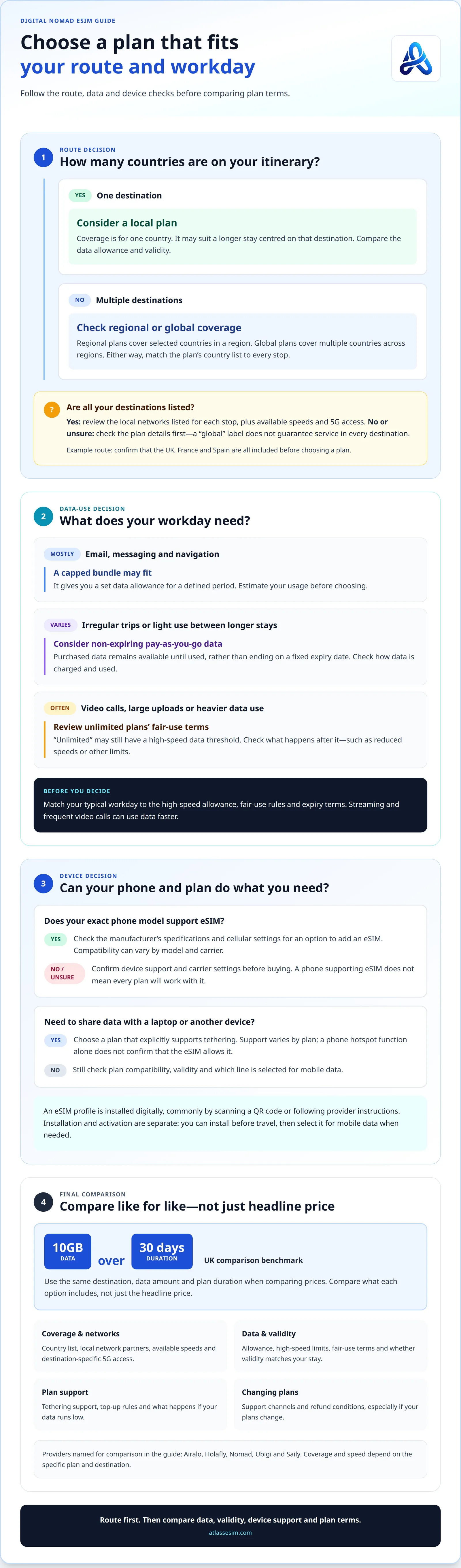
Choosing the best eSIM for digital nomads means matching coverage, data allowance, validity and plan type to your itinerary. To compare prices fairly, use the same destination, data amount and plan duration. A UK comparison benchmark, for example, is 10GB over 30 days. Compare what each option includes, not just its headline price.
Check coverage country by country. A global label doesn’t guarantee service in every destination, and regional plans may cover selected countries only. If your route includes the UK, France and Spain, confirm that all three are listed in the plan details. Then review the local networks listed for each stop.
Airalo, Holafly, Nomad, Ubigi and Saily can be compared using the same criteria. Coverage and speed depend on the specific plan and destination, so review listed network partners, available speeds, data limits and validity. Reliability also depends on local network access and signal where you travel.
| Plan option | Coverage fit | Pricing comparison | Best for |
|---|---|---|---|
| Local | One country | Compare allowance and validity | A longer stay in one destination |
| Regional | Selected countries in a region | Compare included countries and total data | A multi-country route |
| Global | Multiple countries across regions | Compare included destinations with your itinerary | Frequent international travel |
For frequent travel, map each stop against the plan’s country list. Regional or global plans can reduce plan changes across borders; local plans may suit stays centred on one country. Check destination details for 5G access and confirm your device supports the stated features.
Support, refunds and top-ups also affect a plan’s value. Compare support channels, refund conditions and top-up rules, especially if your data runs low or your plans change. To find the best eSIM for digital nomads, choose an option whose coverage, data terms and support fit your route.
Why use an eSIM as a digital nomad?
An eSIM lets a compatible phone connect to mobile data while you travel. For remote work, compare the high-speed allowance and fair-use terms, not just the plan’s “unlimited” label.
Unlimited Data Plans
An unlimited plan is designed for ongoing data use, but its fair-use policy may limit how much high-speed data is available. After that allowance, a provider may reduce speeds or apply other limits. Read the plan terms to understand the threshold and what happens next. This matters for video calls, large uploads and other work that needs a steady, fast connection.
Non-Expiring Pay-as-You-Go Data
With non-expiring pay-as-you-go data, purchased data remains available until used, rather than ending on a fixed expiry date. This can suit irregular trips or light use between longer stays. Compare this model with a capped bundle: pay-as-you-go prioritises flexibility, while a bundle provides a set allowance for a defined period. Check the terms to see how data is charged and used.
A capped plan gives you a fixed data allowance, making it easier to plan your usage. It may suit work focused on email, messaging and navigation. Streaming and frequent video calls can use data faster, so estimate your needs before choosing. Unlimited plans can suit heavier use, but high-speed limits still affect the experience.
A digital nomad moving between countries in Europe may need data for calls, work platforms and maps. An eSIM can provide mobile data while you keep your home SIM active for calls and SMS. The eSIM connects to a supported network, while your primary number remains available on its existing line. Availability and performance depend on the plan and destination.
Match your typical workday to the plan’s high-speed allowance, fair-use rules and expiry terms. If your usage varies from trip to trip, flexible data may suit you better than a fixed bundle.
How eSIMs work and phone compatibility
An eSIM is a digital SIM profile installed on a compatible phone instead of a card inserted into it. Before buying, check device support and carrier settings, and consider whether the plan supports your laptop tethering needs.
Phone Compatibility
Most phones released from 2020 onwards support eSIM, but compatibility still depends on the device model and carrier. An iPhone or Android phone may support eSIM in one version and differ in another. Check the manufacturer’s device specifications and the phone’s cellular settings for an option to add an eSIM. A compatible device is the starting point; it doesn’t establish that every plan will work with it.
ESIM Setup
After purchase, you can typically install the eSIM profile by scanning a QR code or following the provider’s device instructions. The profile stores the mobile plan digitally, so there’s no physical card to insert. Installation and activation are separate steps: you can install the profile before travel, then select it for mobile data when needed. Follow the plan instructions to make sure the intended line is active for data.
For laptop hotspot or tethering, choose a plan that explicitly supports sharing its connection with other devices. Support varies by plan, so don’t assume that a phone’s hotspot function means every eSIM allows tethering. For example, a remote worker joining laptop video calls should account for shared data use as well as phone browsing.
Also consider your existing carrier line. On compatible devices, an eSIM can work alongside a physical SIM, but dual-line features vary by phone. Keep the intended data line selected, especially if your phone uses a separate line for your number. A regional plan can suit travel across several covered countries, while a local plan fits one destination.
Plan duration matters too. Compare the stated validity with your stay, whether it is a 30-day trip or a longer monthly arrangement. If you’re travelling across borders, regional eSIM plans can match a multi-country itinerary, provided the countries you need are covered.
Travel eSIM benefits for digital nomads
For digital nomads, a travel eSIM can keep mobile data available for maps, work tools and hotspot use while travelling. Its value depends on practical details: whether the plan supports tethering, what data it includes, and whether calls or texts matter for your trip.
Many travel eSIM plans are data-only. They provide mobile connectivity for apps such as email and messaging, but may not include a phone number, voice calls or SMS. Check the plan’s stated features and keep your regular number available if you rely on it for calls or verification texts.
Banking and two-factor authentication need extra thought. For example, your bank may send a login code by SMS to the number registered with your account, and a data-only eSIM won’t receive that text. Keep access to your existing number or use another authentication method supported by the service. For privacy, use trusted networks and the security settings you normally rely on. Emergency calling depends on your phone’s active line and local network access, so don’t treat a data plan as a voice service.
A hotspot can help when your laptop needs internet at a café in Thailand or a coworking space elsewhere. Tethering shares your phone’s mobile data, so laptop calls, cloud backups and downloads all use the plan’s allowance. Unlimited data doesn’t automatically mean unlimited high-speed hotspot data; read the plan terms for sharing rules and fair-use limits before buying.
Compare eSIM providers by matching plan features to your work routine, not by the word “unlimited” alone. For a short stay, a capped plan may cover messaging and maps; frequent laptop meetings call for closer attention to speed limits and tethering. Choose a plan around the connection you need, then explore travel eSIM options that fit your route.
Choose a travel eSIM whose stated plan features allow hotspot use and tethering; check its sharing rules and fair-use limits before buying.
Atlas eSIM
Atlas eSIM helps digital nomads match prepaid mobile data plans to the countries on their itinerary. Choose a local eSIM data plan for a stay in one country, or a Regional Plan for a route across several covered destinations. Prices and data allowances are shown upfront, so you can compare plans with your expected use before buying.
After purchase, customers usually receive an installable QR code in under 60 seconds. That can make preparing for travel more straightforward, while a compatible phone handles the digital SIM profile. These options are useful when you want travel data without swapping a physical SIM as you move between destinations.
For a plan that fits your route, data needs and compatible device, contact Atlas eSIM.
Make your next trip easier to plan
Your connectivity needs can change as your work and travel routine evolves. A month working from one base may call for a different setup than a route with frequent border crossings. For each new itinerary, match your data plan to how you’ll work, communicate and get around.
Choosing the best eSIM for digital nomads is less about finding one universal winner and more about finding a practical fit for your next stretch of travel. Consider where you’ll be, how you’ll use your phone and whether your work depends on sharing its connection with a laptop. A plan that fits those needs makes it easier to focus on your work and the places ahead.
If you’d like help finding an option for your travel plans, Contact Atlas eSIM for plan advice. Take the next step with a setup that fits the way you travel.
Frequently Asked Questions
How much do popular travel eSIM plans cost by region and data allowance?
Plan prices vary by destination, coverage, data allowance and validity, so compare similar bundles rather than different plan types. For example, compare plans covering the same countries, with the same data allowance and duration. Atlas eSIM shows prepaid plan prices and data allowances before checkout, so you can assess the total against your trip needs instead of relying on a broad regional average.
Which eSIM providers offer unlimited data, and what are their fair-use limits or speed throttling rules?
Atlas eSIM offers Unlimited Data plans, with fair-use rules shown upfront. Terms can differ by plan, so check what happens after any high-speed allowance and whether speeds or hotspot use are affected. For a work trip with frequent video calls, review the exact fair-use conditions for the plan you’re considering instead of assuming “unlimited” means unrestricted high-speed use.
What should I check to confirm my phone supports eSIM and is carrier-unlocked?
Confirm that your exact phone model supports eSIM and can use another carrier’s service. Atlas eSIM works with most iPhone XS and newer models, and many recent Android devices. Check our compatible devices list before you buy. Carrier-lock status is separate from eSIM support, so check your phone’s settings or ask your current carrier whether the device can use a travel plan from another carrier.
What should I know before installing and activating a travel eSIM, including when to turn it on?
Install the eSIM before departure while you have reliable Wi-Fi, then follow the plan’s instructions to activate it. Installation adds the profile to your phone; turning on its data line is a separate step. With Atlas eSIM, you can install before leaving and start using data when you begin using it at your destination. Keep the instructions accessible during your trip.
What are the best eSIM providers for digital nomads in 2026?
Airalo, Holafly, Nomad, Ubigi and Saily are providers you can compare, but the best choice depends on your route, data needs, plan validity and coverage. Check that the plan covers every destination on your itinerary.
How do Airalo, Holafly, Nomad, Ubigi, and Saily compare for coverage, speed, and reliability?
There’s no single overall ranking: coverage and speed depend on the specific plan and destination. Compare each plan’s listed network partners, available speeds, data limits and validity. Reliability also depends on local network access and signal.